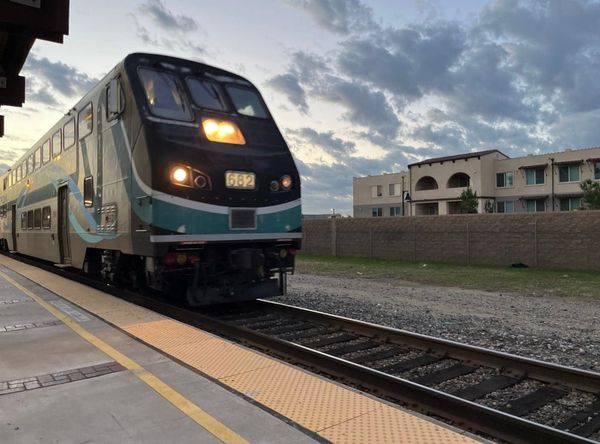
It has been a dramatic week for the Southern California Regional Rail Authority, the governing entity for Metrolink. After months of uncertainty surrounding the agency's budget, looming service cuts, a grant from CalSTA at the last minute provided $20 million, which will cover the budget gap until after the Olympics in 2028, averting cuts, at least for now. The board approved the new budget, using the grant on Friday, Nov. 13.
This grant was possible in part due to the effort of rail advocacy groups who co-signed Metrolink's grant proposal to CalSTA.
Then, on Nov. 17, CEO Darren Kettle made the seemingly sudden announcement that he would be resigning from Metrolink, allegedly in response to criticism over the proposed cuts by Metrolink to all lines.
CEO Kettle's resignation is, however, unsurprising in context. The position is largely thankless and the subject of intense scrutiny, more so this year than usual. It similarly is not hard to feel that Kettle is being made into a scapegoat for the animosity toward Metrolink's member agencies for the budget crisis.
Despite comments from some of Metrolink's board, there was very little that Kettle could have done to reduce operating costs. Metrolink is already an extremely lean operation, perhaps too lean. From board meetings in October, Metrolink's staff admitted a lack of support staff (discussed beginning 56:31) to manage contracts for parts acquisition, and a lack of funding to purchase parts. And in the approved budget in November, and from budget discussions in July, the Metrolink budget only narrowly manages to keep its accounts in the black by forgoing merit increases for staff and by severely curtailing the size of its staff.
Alstom, the contractor that handles Metrolink's operations, was criticized for cannibalizing locomotives, removing parts from locomotives to fix others, a decision which can only be interpreted as a desperate attempt to maintain the fleet in the face of a lack of spare parts. This was precipitated by a failure in the fueling components (discussed beginning 47:28) of Metrolink's EMD 125 locomotive engines, which led to the initial 20% service reductions in March of this year. Metrolink is the only passenger railroad in the United States to use these engines, which has resulted in issues acquiring enough parts for the mostly bespoke unit. Despite the influx of state funding, these cuts are not going to be reversed, and will remain permanent until a maintenance backlog is reversed.
The single largest expense that Metrolink has is not its operations budget, but in the cost of track maintenance. This is a fixed cost. The only way to avoid this cost is to not maintain the track — this is not a wise decision and was strongly advised against at the Nov. 13 board meeting.
Where does this leave Metrolink? Metrolink is currently facing an identity crisis. Lack of clear leadership and communication between Metrolink and the county transit commissions, including uncertainty over the future of specific infrastructure projects, and no permanent solution to the structural issues facing Metrolink mean that while a crisis has been averted, a looming question still hangs over the commuter rail agency.
For Riverside and San Bernardino county commuters, the question that matters is this: will Metrolink trains continue to run on time and will they have a convenient schedule? And is Metrolink's current structure and leadership capable of delivering this?
With the tightening of the staff budget, there are potential problems looming with labor relations. A hiring freeze will result in very tight staff schedules and the lack of merit increases could create friction between the board and the people who run the trains. And Metrolink still has concerns with Alstom which could influence contract negotiations that could create their own problems.
As for frequency and convenience, it really depends on what riders consider convenient for them. Metrolink schedules remain unchanged, and in the Inland Empire there are fewer options for riders in Riverside than riders in San Bernardino, with service concluding roughly in the middle of the evening. This may not work for some riders but does for others, but the point is that these schedules should remain unchanged — no improvements, but no reductions.
But ultimately Metrolink still has not found a solution to its funding problems. A permanent funding mechanism has not been established and the agency potentially faces a repeat of this year's crisis in 2028.
Metrolink, however, can avoid this through governance reform. There are legislative options that can reform Metrolink into a larger and more forward-thinking platform for transit in Southern California, and while these options may be difficult, they are not impossible. Reforming Metrolink and regional rail, such as through a special transit district, can enable the use of a modest regional tax to fully fund operations and infrastructure improvements, such as Metrolink's proposed SCORE program.
Additionally, steps can be taken incrementally by the board to resolve several problems already. The first would be a reversal of cuts made by LA Metro and OCTA and to return funding to 2025 levels. Riverside and San Bernardino have indicated that they will likewise increase their share of funding contributions in 2027.
One idea suggested at the recent board meeting by Director Trembley was to create a special board committee that would regularly meet with the CEOs of member agencies of Metrolink's JPA, fostering clear communication between the agencies.
It is clear from this week, however, that there is still much work to be done.
I am a graduate student of the University of California, Riverside and a member of Californians for Electric Rail, an advocacy group supporting the electrification of Metrolink and other regional rail networks in California. I am a volunteer archivist at the Southern California Railway Museum and a historian of the public transportation network in Southern California.
By Cooper Crane