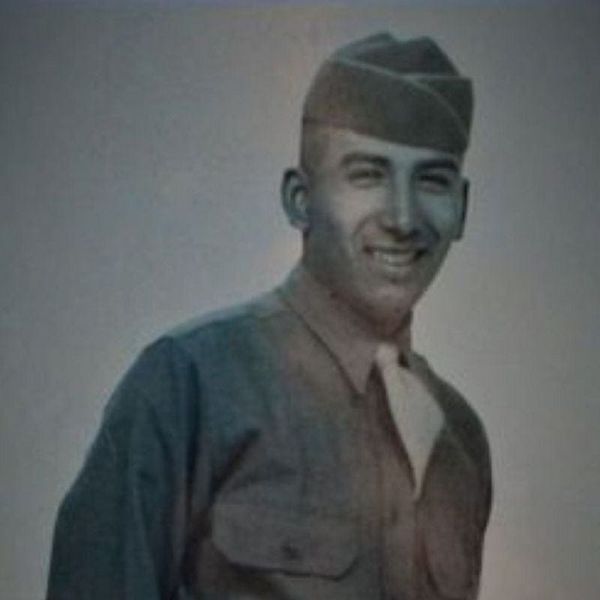
This Veterans Day, let’s remember Riverside County’s first Medal of Honor recipient, Ysmael Villegas. Staff Sgt. Villegas showed extraordinary courage during the Battle of Luzon in the Philippines, a crucial battle in the Pacific theater of World War II. On March 20, 1945, Villegas took out a series of Japanese entrenchments in the midst of a firefight on the Villa Verde Trail, a key route through the Caraballo Mountains, a range which helped the occupying Japanese maintain control over the island. Villegas died that day while storming the sixth and final Japanese stronghold. His compatriots rallied to overcome the Japanese forces that day and would soon take control of Luzon. Later that year, President Harry Truman awarded Villegas the Medal of Honor posthumously.
More than 80 years later, Villegas’ memory is still held dear locally. He serves as the namesake of a park, a school, and has been honored with a statue in Riverside’s Main Street Civic Center Courtyard.
“We remember and honor Ysmael Villegas as we encourage every student to reach their unlimited potential by demonstrating these values as a Villegas Patriot. Every student, by name, is valued at our school and in our district,” said Amber Fleeman, who has taught at Villegas Middle School in Riverside since it opened in 2002.
Villegas Middle School is located about seven miles west of Casa Blanca, the then-unincorporated settlement where its namesake was raised. Casa Blanca is now a neighborhood in the city of Riverside.
Ysmael Reyes Villegas was born on March 21, 1924, in Casa Blanca. He was the eldest of Dario and Inez Villegas’ 13 children. His parents both came from Mexico. His father was born in Michoacán and his mother came from Torreón. Like many Mexican American families in Casa Blanca, their family worked the area’s thriving orange groves.
The Villegas family resided in a small home at 3105 Madison Street. “Smiley,” as the perpetually cheerful young man was known, entered Casa Blanca primary school in 1929. After completing primary school, he spent seventh through ninth grade at Chemawa Middle School. Teachers described him as attentive and well behaved. He displayed a passion for drawing throughout his school days.
Ysmael quit school after ninth grade to work alongside his father in Casa Blanca’s orange groves. As a young adult, he displayed a passion for dancing and working on cars.
In 1943, Ysmael met 18-year-old Lillie Sanchez while she was working at the Riverside Arlington Heights Fruit Exchange. Sanchez resided in the city of Riverside with her parents. Ysmael and Lillie soon became inseparable.
Less than a year later, Lillie and Ysmael married at St. Anthony’s Catholic Church in Casa Blanca.
Villegas enlisted in the U.S. Army in July 1944. He completed basic training initially at Camp Roberts, a National Guard base located on the Salinas River. He completed his training at Fort Sill, Okla.. He returned to Riverside in October for a furlough before joining the 32nd Infantry Division in the Philippines. Villegas excelled at both the physical and mental aspects of soldiering as a member of the 127th Infantry. He rose to the rank of Staff Sergeant and became a squad leader in Company F.
His younger brother Dario served in the Philippines as well. He belonged to a paratrooper unit in the U.S. Army.
Smiley wrote letters to his sisters and his pregnant wife every week from the Pacific.
Ysmael tried to keep the tone light in his letters, but he and his comrades faced some treacherous days in the Philippines. American forces found themselves in a series of pitched battles on the island of Luzon as they sought to reclaim it from the Japanese.
On March 1, 1945, Villegas’ squad encountered a machine gun nest along the Villa Verde Trail. Villegas stormed the nest and killed its occupants. He was later awarded the Silver Star for his actions that day.
On March 20, 1945, Villegas’ squad was ordered to take a hill further along the Villa Verde Trail. American forces had been bogged down in Luzon for weeks as the Japanese fought ferociously to maintain every acre of the island.
That afternoon, Staff Sgt. Villegas’ squad came into contact with entrenched enemies who controlled a series of caves and foxholes. The Japanese forces pinned them down with machine gun fire and grenades. Amid the firefight, Villegas rallied his men to assert their position. Villegas charged forward, attacking the foxholes, bear crawling from one to the next. He killed the Japanese opposition in a succession of five caves and foxholes, rushing their position and shooting them at point-blank range. As he neared a sixth enemy position, he was shot and killed. It was the day before his 21st birthday.
Villegas’ squad rallied and seized the final machine gun nest, taking the hill. The American victory that afternoon was one in a series of small victories that led to the conquest of Luzon. By the end of March, the United States had seized the island’s most strategic sections, though pockets of Japanese resistance remained until Japan’s unconditional surrender on August 15.
Lillie, who was more than eight months pregnant, received a letter from her husband on April 7, 1945, dated March 17. He had been wounded during the March 1st assault. A hand grenade had blown up close to his ear, causing hearing damage. He told her not to worry if she saw his name on the casualty list in the newspaper. Later that day, a telegram arrived that informed her of Ysmael’s death on March 20th.
Ysmael never met his son, Charles Ysmael Villegas, who was born a month after his father’s death.
Villegas’ body arrived back in Riverside on July 22, 1945. Later that month, memorials for Villegas were held at Casa Blanca High School and St. Anthony’s Catholic Church.
A reported 3,000 people filed by his flag-draped casket at the memorial held at the high school. St. Anthony was filled with friends and family to mourn the fallen hero. He would be interred at nearby Olivewood Cemetery in Riverside.
Riverside residents set up a memorial fund to support Staff Sgt. Villegas’ family.
American Legion Post 79 in Riverside held a benefit in August. It came in the form of a professional wrestling show held under the stars at Evans Park. Event promoters sold out the event in advance. Originally, Bob Hope was scheduled to host the wrestling show. He had to cancel after being knocked out cold while filming a horse-riding scene on the Paramount studio lot in Hollywood. The injured star sent in a large donation instead.
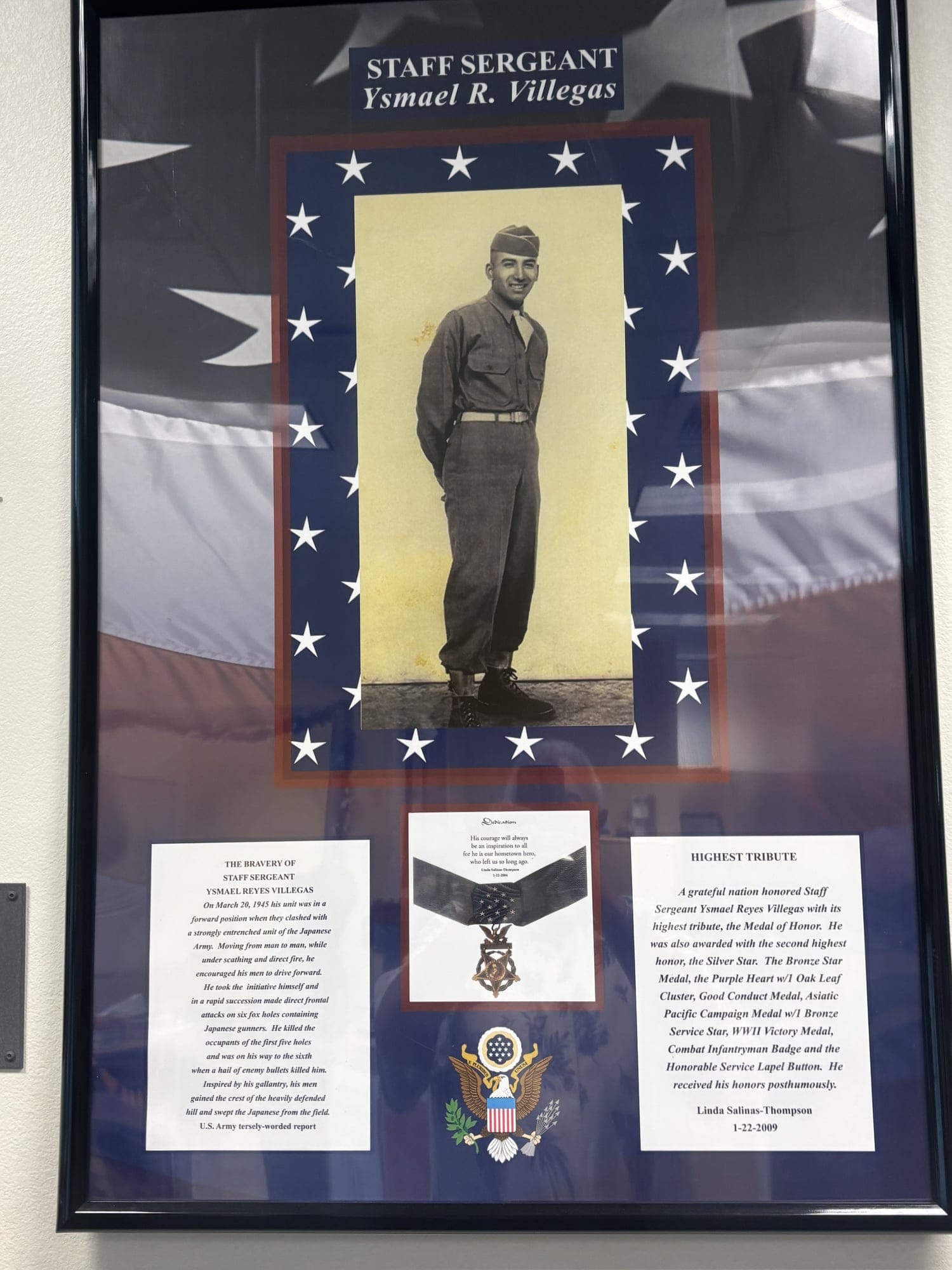
On October 19, 1945, President Truman awarded the Medal of Honor to Villegas. The formal presentation of the nation’s highest military honor took place on November 1st at Camp Haan, which evolved into the March Field air base.
2,000 spectators honored Staff Sargeant Villegas at Camp Haan that afternoon. Seven companies of soldiers from Camp Haan participated in a formal review ceremony.
The school children of Casa Blanca formed a significant portion of the audience. A series of buses had shuttled the children to the sunset ceremony at the conclusion of afternoon classes.
Lieutenant Oliver Allen read President Truman’s proclamation. Colonel G.B. Appleman presented the Medal of Honor, the nation’s top military honor, to Lillie and her seven-month-old son.
The next day, Lillie brought the Medal of Honor to Casa Blanca primary school so that the children could see it up close. “Smiley” had attended the school. At the time, several of his younger siblings were still in attendance there.
In subsequent years, Riverside has honored Villegas in numerous ways.
The city of Riverside named Ysmael Villegas Park in Casa Blanca after him in 1952. It has since evolved into the Ysmael Villegas Park and Community Center. Ysmael R. Villegas Middle School, which opened in 2002, was also named in his honor. A memorial statue of Villegas was dedicated in 1995 in Riverside’s Main Street Civic Center Courtyard.
Villegas Middle School is currently celebrating its 25th anniversary in the Alvord Unified School District.
“Ysmael Villegas is honored by our school as students learn the history of his heroism in their classes and during library visits. He is recognized in our front office and our library, both places where visitors can see and learn more about him,” Fleeman said.
In 1978, Villegas’ body was moved to Riverside National Cemetery, where he became the national military cemetery’s first burial. Several members of his family attended the ceremony at the new cemetery, which is the largest national cemetery in the Western United States. More than 300,000 veterans and eligible family members have been buried among its 921 acres.