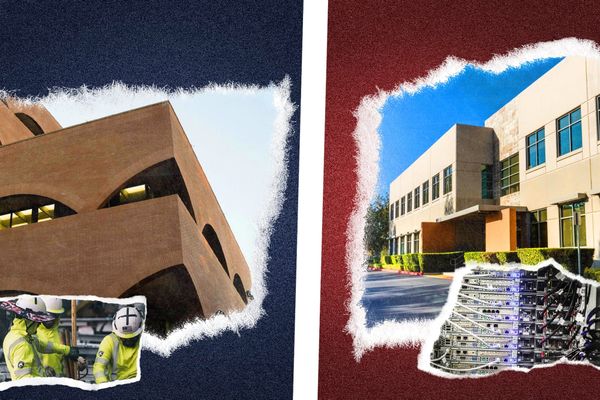
The Braver Angels Riverside Alliance asked two Riversiders the same question: Should Riverside consider a moratorium on data center development? They were also asked what the most important benefit or risk would be in a city that owns its own utility, and what would need to happen for them to feel the community's interests were protected. Keith Nelson, a cybersecurity executive who has spent nearly three decades supporting critical infrastructure, opposes a moratorium. Justin Scott-Coe, a former member of the city's Board of Public Utilities who has lived in Riverside for nearly 30 years, supports one.
Keith Nelson: Negotiate From Strength
Riverside calls itself the City of Arts & Innovation. Yet its Land Use Committee's response to a strategically important industry has been remarkably simple: stop it first, study it later. Apparently, in Riverside, conclusions can precede evidence.
The timing deserves scrutiny. Data centers have become a national political flashpoint, and Riverside's debate has taken on a distinctly partisan tone. Councilmember Clarissa Cervantes chairs the Land Use Committee while running for state Assembly; I have personally seen campaign advertising in which she opposes data centers. Campaigning on policy is legitimate, and it does not automatically require recusal. But residents are entitled to ask whether the committee is independently examining alternatives or reinforcing a position already useful on the campaign trail.
The September Land Use Committee unanimously advanced a temporary moratorium while requesting more detailed definitions of electricity and water use. A short pause for genuine research may be defensible. A pause used as a runway to a predetermined ban is not. Proactive land-use planning means writing enforceable standards, not shielding elected officials from ever having to evaluate a difficult proposal.
That distinction matters because Riverside's economic and financial record hardly inspires unquestioning confidence. The city's Ohmio agreement initially contemplated up to $2.5 million in public commitments against projections of seven initial direct jobs and at least 25 by year three; outside funding later reduced the anticipated city cost. The council approved approximately $2.39 million for Voltu trucks and $1.96 million for Chaevi chargers. These are purchases and commitments, not proof that the companies failed. I hope they succeed. But where is the transparent, independently verified scorecard showing dollars actually spent, jobs actually delivered, tax revenue collected and infrastructure costs incurred?
Riverside has too often looked like an angel investor purchasing products from companies it hopes to recruit. Yet the prospect of private investors financing their own substantial infrastructure apparently triggers talk of prohibition. That is an extraordinary inversion of economic-development priorities.
The technical questions are difficult. Data centers can impose major power loads, consume water, generate noise and employ relatively few permanent workers. That is precisely why negotiations require competent utility engineering, finance, cybersecurity, land-use planning and contract expertise. Does this council possess that expertise, or has it demonstrated the ability to assemble independent specialists and negotiate from strength? Its handling of the second transmission connection — including disputed overhead segments despite community objections — makes that a fair question.
Other communities offer lessons, not guarantees. Loudoun County, Virginia, reports that data centers occupy about 4% of commercial parcels while providing roughly 38% of general fund revenue. Grant PUD in Washington has expanded transmission serving data center demand and expects large power users to pay for additional resources and infrastructure attributable to their growth. Those results deserve examination alongside genuine problems involving electricity prices, water and land use.
Riverside owns its electric utility. That should be leverage, not an excuse for surrender. Require developers to pay attributable generation, substation and transmission costs; establish large-load rates and long-term financial guarantees; impose strict water, noise and emissions limits; and investigate whether new private investment can support grid modernization or additional undergrounding where feasible. If the numbers do not protect residents and ratepayers, reject the project.
And a citywide ban will not stop regional demand. Federal facilities, tribal jurisdictions and neighboring cities operate under different authorities. March Air Reserve Base is nearby, although no specific data center project there has been established. Regional power and transportation impacts can cross boundaries; local tax receipts generally do not. We already know this dynamic from port expansion and the Inland Empire's warehouse economy: more trucks, congestion, road wear and pollution do not respect city limits.
The Braver Angels question is whether a moratorium protects Riverside. My answer: only if it produces credible research, clear deadlines and objective standards — not political cover for a permanent ban. Riverside does not need to approve a single data center. It needs leaders capable of judging an actual proposal, negotiating real benefits and saying no when necessary.
Governance takes research, experience, financial discipline and imagination. Chanting "ban" takes none of them. If Riverside refuses even to consider private technology investment while continuing down the warehouse-and-logistics path, perhaps the welcome sign should read: "Riverside — Closed for Business. City of Logistics and Warehouses."
Justin Scott-Coe: Community Standards and Values
Data centers are a hot-button issue in local communities across California and the country. On Oct. 13, the Riverside City Council's Land Use Committee forwarded a recommendation to the full council either to adopt a 45-day moratorium on data center development or to interpret the existing municipal code to prohibit data centers altogether. In considering a potential long-term moratorium or prohibition of data center development in Riverside, our leaders and residents should first consider whether our city has sufficient resources — water, energy and land — to support these facilities. In addition, we must also consider whether data centers and the major industries they serve — social media, cryptocurrencies and artificial intelligence (AI) — meet our community standards and values. In the end, I believe a long-term data center moratorium is appropriate, not because we can't support these facilities, but because we shouldn't.
First, Riverside needs to rely on our city's professional staff with direct knowledge of our long-term resource strategies and adopted planning documents to evaluate the availability of city-owned resources. Riverside is fortunate, through Riverside Public Utilities, to own and manage both its electric and water systems. Riverside is also fortunate, through skillful lawyering in the 1960s and ongoing management, to have secured a robust local water supply; as demonstrated in its most recent Urban Water Management Plan, Riverside has surplus water resources available (especially recycled water). On the electric side, Riverside's second connection to the statewide grid is (finally!) under construction. Once completed, as demonstrated in our electric utility's most recent Integrated Resource Plan, the city will have sufficient energy capacity for major new industrial developments. And lastly, the city's General Plan (currently being updated) identifies industrial zones where new data centers, once identified as a permitted use in our municipal code, could be located.
However, just because Riverside may have the resources to allow data center development doesn't mean such development should occur. Over the past decades, data centers have been built across the country to support industries and services requiring large computing capacities. The transition to "cloud" services is one example, where software and files, photos and videos are stored outside one's computer or commercial server — i.e., at a data center. The growth of social media usage has required significantly more data centers to store the photos and videos generated by millions of users. Similarly, cryptocurrencies — electronically generated and stored money substitutes — have created their own data center boom.
And then came AI, which has triggered a staggering recent increase in data center construction, as well as the current backlash. AI, contrary to how some want to define it, is not "super intelligence." AI is a tool, and like all tools, it has been developed by humans to do things we cannot do on our own. AI's capabilities are substantial, but it is still we humans who are using AI, both for good and for ill. And when AI does bad things — hacking critical systems, designing viruses, overusing em dashes — it reflects the worst of humanity, not of AI. It is up to us humans to control the tools we create.
The same goes for data centers, which are themselves tools used to support AI and other compute-intensive technologies. As Riversiders, we can ask ourselves, "Do the industries building data centers do more to help or to harm human lives?" To be sure, the vast computing capacities of these data centers could be used to improve society, from saving lives through scientific breakthroughs to increasing knowledge for our collective benefit. Unfortunately, we already know the harm caused by the main users of large data centers: social media's negative impact on our youth, as demonstrated in recent court rulings and settlements; cryptocurrencies' support for crime and corruption; AI's threat to local, national and global financial and critical infrastructure systems, and worse. The fact that none of these industries have been appropriately regulated by the federal or state government should give us pause to consider what we can — and should — do locally.
By creating community standards for the appropriate use of our water, energy and land resources, Riverside can be a leader in the national conversation about appropriately regulating as well as supporting cutting-edge technologies. Meanwhile, we should not allow data centers to be built in Riverside until their industrial users can demonstrate they are worthy of our support.
Nelson: No Blank Checks
Justin and I agree on something important: Riverside must protect its water, electricity, land and residents. We also agree that artificial intelligence and other technologies can be misused. Where we differ is whether those concerns justify prohibiting an entire category of infrastructure.
Interestingly, you acknowledge that Riverside has substantial water resources, a second electrical connection under construction (which, with the correct project, could be underground versus 19th-century, dangerous and unstable above ground) and industrial land potentially suitable for data centers. Your argument then shifts from whether Riverside can accommodate them to whether the industries using them are worthy of our support.
That is a philosophical judgment, not an economic-development analysis.
Data centers support far more than social media, cryptocurrency and commercial AI. They support hospitals, emergency services, financial transactions, cybersecurity, scientific research and national-security systems. Should Riverside prohibit infrastructure supporting those essential services because some companies misuse the same technology?
You correctly observed that technology is a tool and humans are responsible for how it is used. Then why punish the infrastructure rather than regulate the activities and impacts that concern us?
More importantly, your argument overlooks what Riverside could negotiate.
Loudoun County, Virginia, reports that data centers occupy approximately 4% of commercial parcels while generating roughly 38% of general fund revenue. Grant PUD in Washington requires large electrical customers to fund infrastructure attributable to their growth.
Riverside owns its utility. We could require developer-funded electrical improvements, strict water and environmental standards, long-term financial guarantees, local workforce investment and measurable taxpayer benefits.
No residential ratepayer subsidies. No unacceptable environmental impacts. No blank checks.
If a developer cannot meet those conditions, reject the project.
Riverside's recent economic-development commitments demonstrate why financial accountability matters. We should demand stronger returns on public resources, not eliminate opportunities for privately financed infrastructure.
A short moratorium devoted to objective research may be reasonable; however, we need people who understand technology, business and finance, not politicians who have failed us so often in the past. A prolonged prohibition based on disapproval of technology companies is another matter.
Mature leadership establishes standards, evaluates actual proposals and negotiates from strength. It does not surrender that responsibility through a blanket ban.
Scott-Coe: Defining Our Community's Standards
Keith rightly cautions our elected leaders to avoid reaching predetermined conclusions on data centers, especially ones laced with politics. We also agree that a short moratorium may be advisable if it allows for what he calls "genuine research" to develop "enforceable standards."
Where Keith and I differ is the lens through which we see data center development. Keith is focused on their economic impact, comparing them to Riverside's recent business partnerships and ongoing struggles with warehouse proliferation. My focus is on the use of data centers by technology industries currently allowed to be unaccountable to the public they serve. City leaders hold a tremendous responsibility to shape economic development in our community, and they must do so reflecting community standards of how our land, water and energy are to be used. This requires both marshalling the expertise of the city's professional staff and understanding the values of their constituents.
Keith provides much for Riverside's leaders to consider in upcoming data center discussions, including the importance of transparency in public-private partnerships, the leverage value of local utility ownership and the cross-boundary impacts of the regional economy. However, I do not share his skepticism that our leaders are not up to the challenge. His focus on one particular councilmember who is running for Assembly seems to ignore the other members of the Land Use Committee, one of whom actually proposed the data center moratorium. And Keith's questioning of the council's support for a second interconnection to the statewide electric grid also seems misplaced and in conflict with his support for the city's future economic growth.
That said, I share Keith's goal for a moratorium that "produces credible research, clear deadlines and objective standards," and I look forward to a robust conversation that defines our community's standards as they apply to industries seeking our partnership.
About the authors
Keith J. Nelson, Ph.D., is CEO and chief information security officer of Vistem Solutions Inc., a technology and cybersecurity firm founded in 1999. He has more than 27 years of experience supporting critical infrastructure, including Southern California's ports, aerospace and other high-security industries.
A Riverside resident for more than 35 years who raised four children in the community, Keith has served in numerous civic leadership roles, including chair of Riverside's Board of Ethics, the Commission on Disabilities, Riverside Unified's Measure O Citizens' Oversight Committee and board chair of the Inland Regional Center. His volunteer service includes Challenger Baseball, AYSO VIP Soccer and Special Olympics, including Team USA.
Justin Scott-Coe has been a Riverside resident for nearly 30 years. Justin has served on the city's Board of Public Utilities and Budget Engagement Commission and on the boards of the Riverside Neighborhood Partnership, Wood Streets Green Team and Tequesquite Community Garden, and he currently serves as president of the Raincross Group. All opinions expressed are his own.
More information: The Braver Angels Riverside Alliance is the local chapter of Braver Angels, a national citizens' movement founded in 2016 that brings conservatives and liberals together through workshops, debates and community events. The Alliance selects each month's question and pairs the writers, who draft their opening arguments separately and exchange them before writing their responses. To learn more, visit braverangels.org.