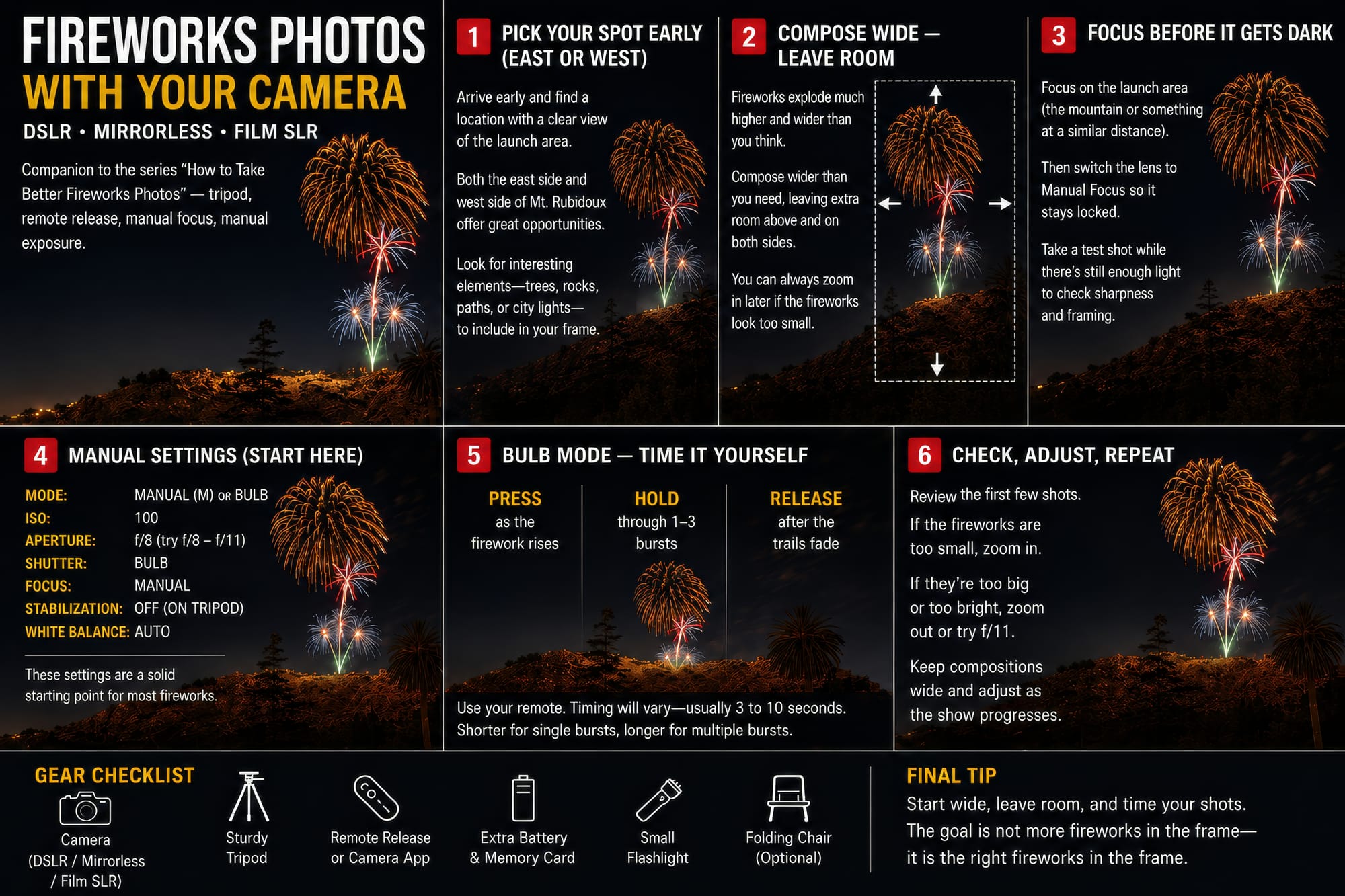
Every year, people point cameras at fireworks and come home with the same results: a black sky, a few blurry streaks, too much smoke, and maybe the back of someone's head glowing red, white, and blue. With the country's 250th birthday on July 4, the show over Mt. Rubidoux should be worth getting right.
The good news is that fireworks are not especially difficult to photograph if you prepare before the show begins. You do not need the newest camera or the most expensive lens. You need a tripod, a remote release, manual focus, manual exposure, and a little patience.
This first part is for those using a DSLR, mirrorless camera, or film SLR. In Part 2, we will look at the smartphone method, which is a different process and works best when you use the phone's own strengths.
Here in Riverside, Mt. Rubidoux gives photographers a strong subject. The fireworks are the main attraction, but the mountain, trees, rocks, spectators, city lights, and the outline of the hillside can make the picture more interesting. A firework by itself is just a burst of light. A firework connected to a recognizable place becomes a photograph.
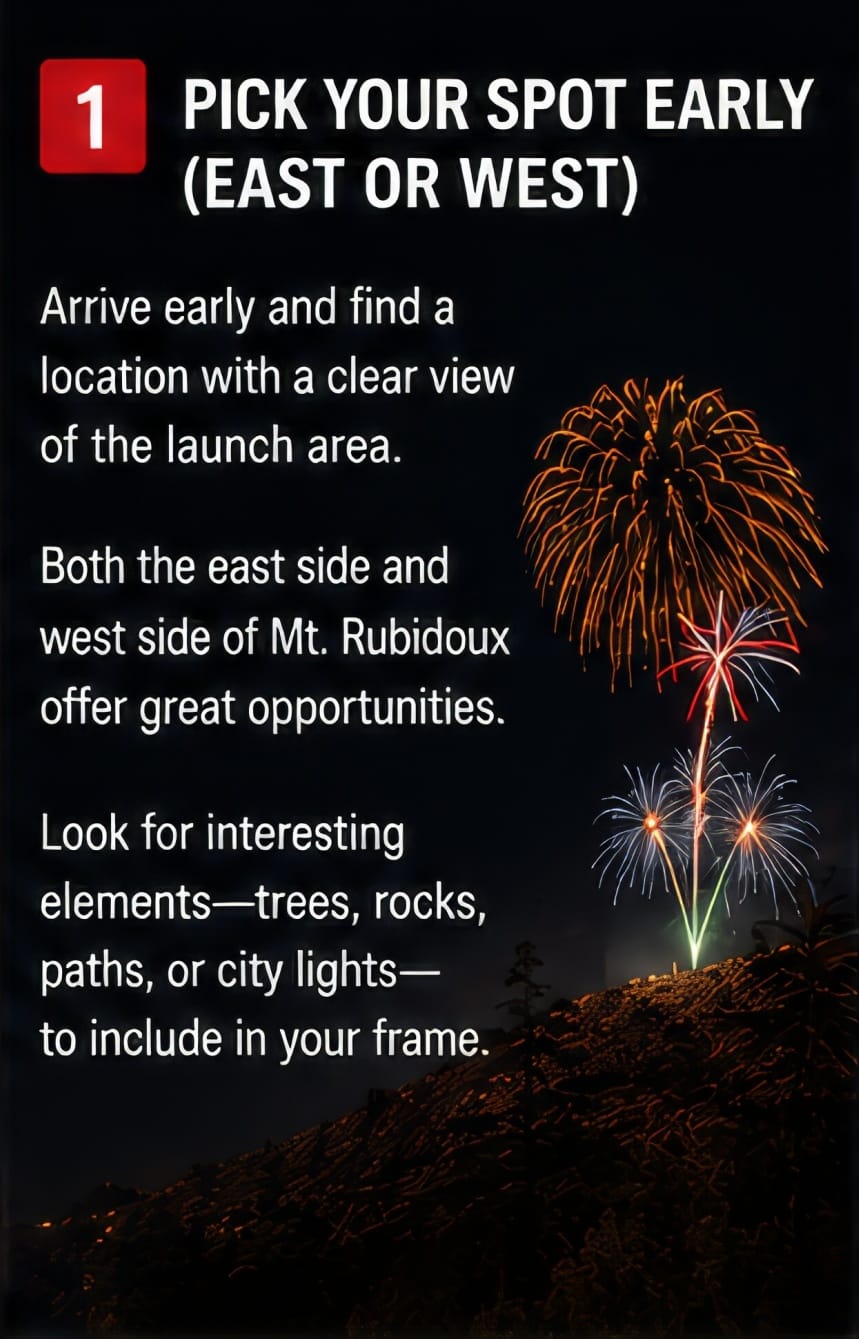
Good pictures can be made from either the east or west side of Mt. Rubidoux. The east side may be the more convenient viewing area, but the west side can produce excellent angles. The best location is the one that gives you a clear view of the launch area, a clean foreground, and enough sky for the largest bursts.
What to Bring
Bring a camera that allows manual exposure, a sturdy tripod, and some kind of remote shutter release. The remote can be a cable release, a wireless trigger, or a camera-control app on your phone.
A zoom lens is very useful. A 35mm lens, or something in that general range, is a good starting point, but a zoom lets you adjust after the first few fireworks show you where the action really is.
Also bring an extra battery, an extra memory card, and a small flashlight. A folding chair is optional but not foolish.
Start Wider Than You Think
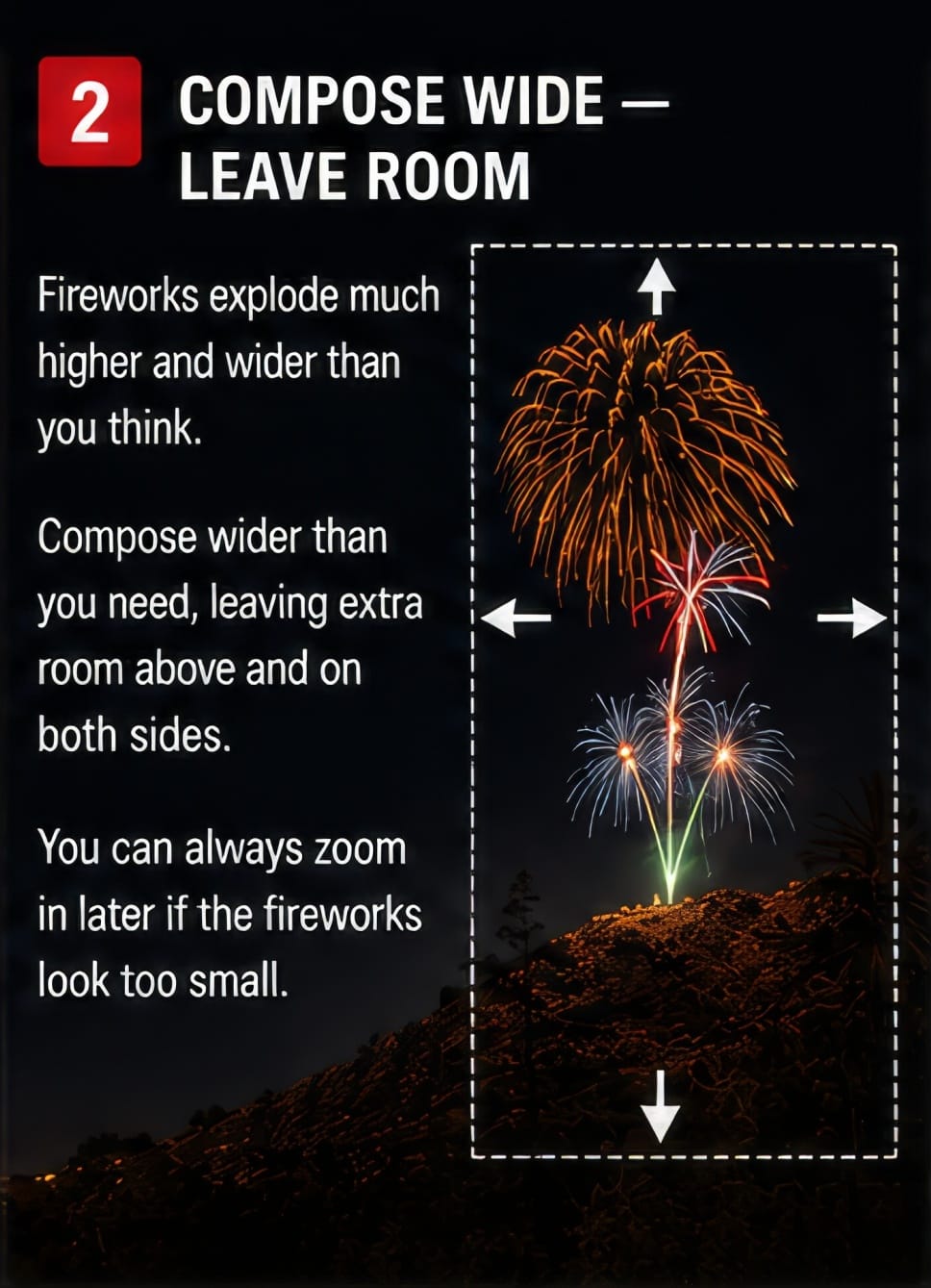
This may be the most important composition tip.
Fireworks rise higher and spread wider than expected. Leave extra room above the mountain and on both sides of the frame. If the fireworks look too small after the first few shots, zoom in. But if you start too tight and the best burst of the night goes outside the frame, there is no way to fix it later.
Begin safely wide, check your early results, then refine the framing.
Arrive Early and Set Up Carefully
Do not arrive at 8:58 p.m. for a 9 p.m. show and expect great photographs. Arrive early enough to find a clear view, set up the tripod, check your composition, and make a few test shots before it gets too dark.
Look through the viewfinder or rear screen and watch for distractions: streetlights, signs, power lines, or people walking through the frame. Foreground elements help only when they are intentional. Trees, silhouettes, rocks, spectators, and the hillside can all work if they support the picture instead of cluttering it.
Focus Before the Show Starts
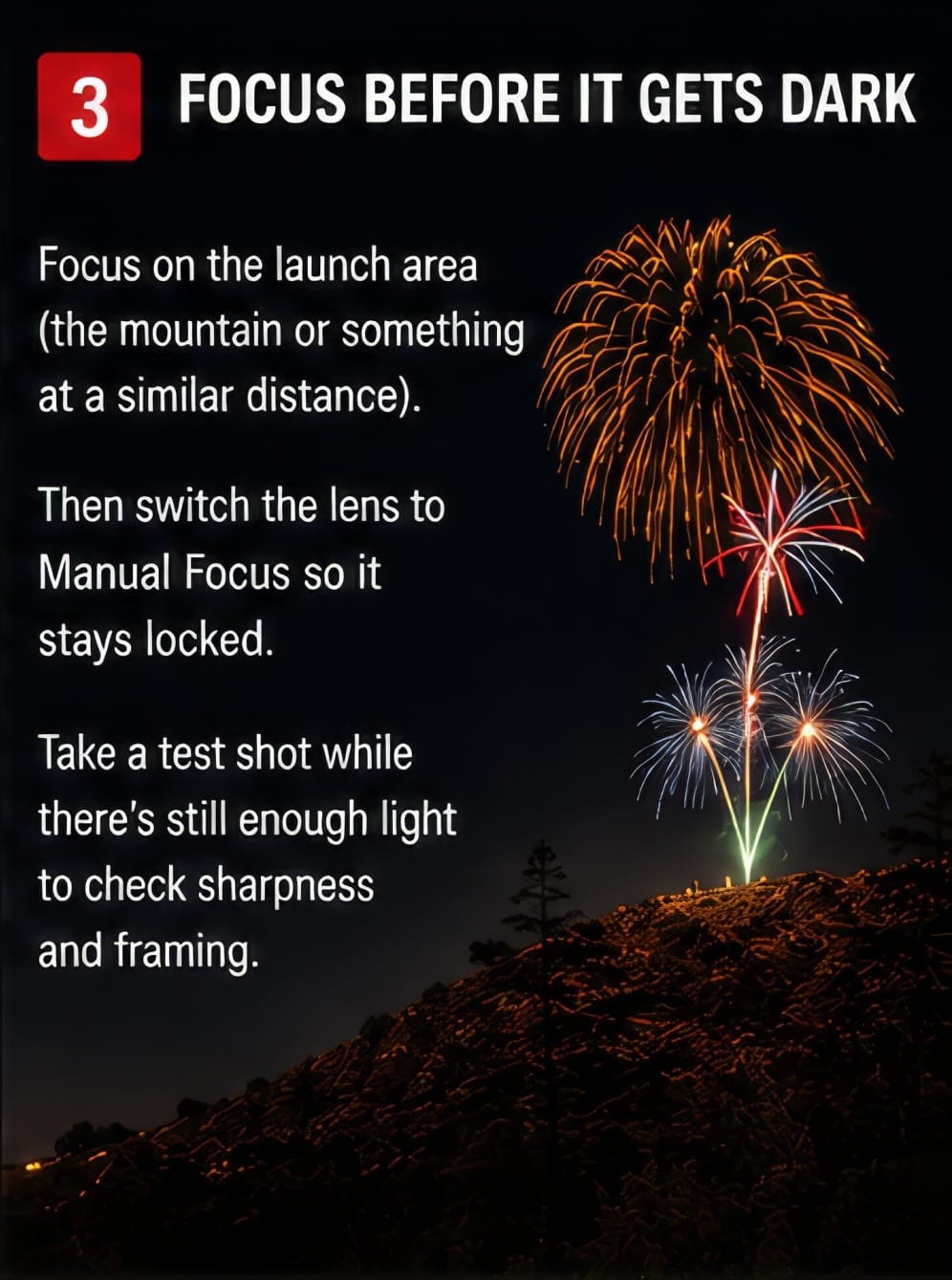
Aim at the mountain, the launch area, a distant light, or another object at a similar distance. Use autofocus while there is still enough light. Once the image is sharp, switch the lens or camera to manual focus so it does not try to refocus during the show.
This matters. Fireworks can fool autofocus systems. The camera may try to focus on smoke, empty sky, or a fading burst, and if it starts hunting in the dark, you will miss the best moments.
Take a test shot and confirm the mountain or foreground is sharp. At typical fireworks distances, infinity focus will usually be close, but do not blindly trust the infinity mark on the lens. Some lenses focus slightly past infinity.
Use Manual Exposure
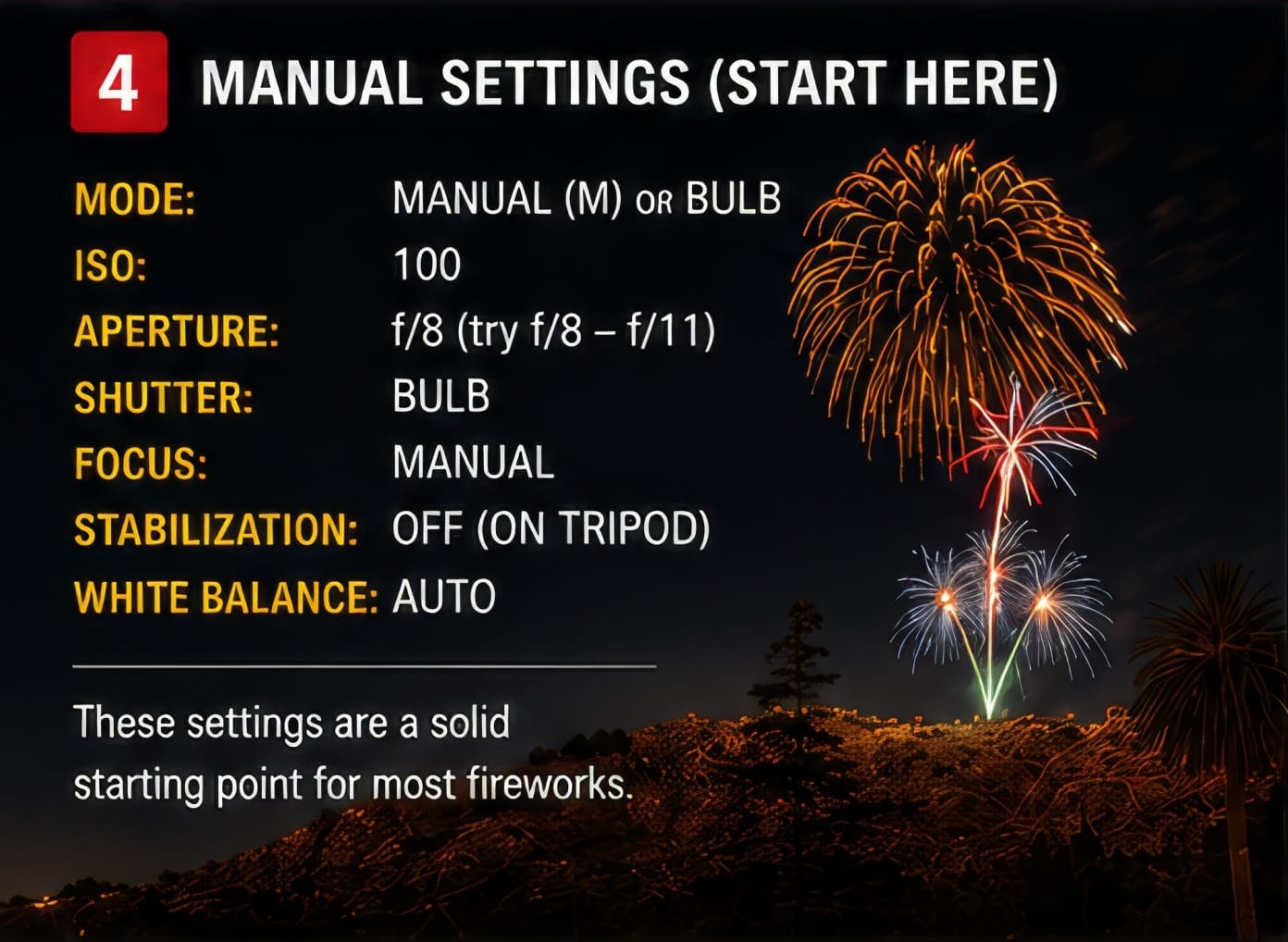
Once focus and framing are set, switch to manual exposure. A reliable starting point:
ISO: 100
Aperture: f/8
Shutter: Bulb
Focus: Manual
White balance: Auto
This works because fireworks are bright. You are not exposing for a dark sky. You are exposing for bright trails of light moving through the frame.
If the fireworks are too bright, try f/11. If they are too dim, try f/5.6. Most of the time, ISO 100 and f/8 will get you very close.
If your camera or lens has image stabilization, turn it off once the camera is locked down on the tripod, unless your manual specifically says the stabilization system is designed for tripod use.
Use Bulb Mode
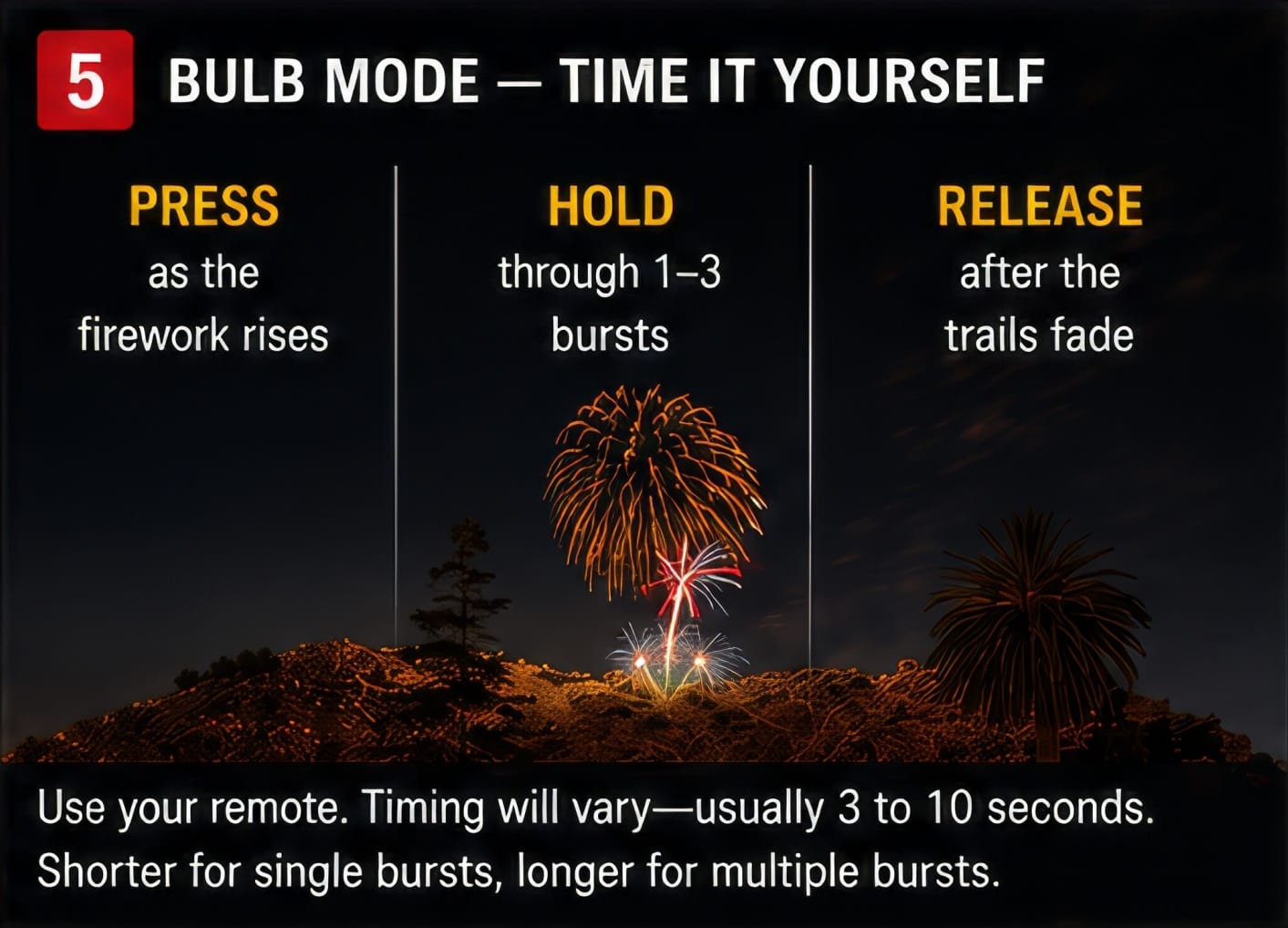
Bulb mode makes fireworks photography much easier. In Bulb, the shutter stays open as long as you hold the remote release. Press when you see or hear the firework launch. Hold through the burst. Release after the trails fade.
That may be three seconds. It may be six. Sometimes closer to ten.
A good rhythm is simple: open the shutter as the firework rises, hold through one or two bursts, and release before the frame gets too crowded. Then start again with the next one.
A fixed shutter speed of five or eight seconds can work, but Bulb gives you better control. You decide when the photograph has enough light.
Review and Adjust
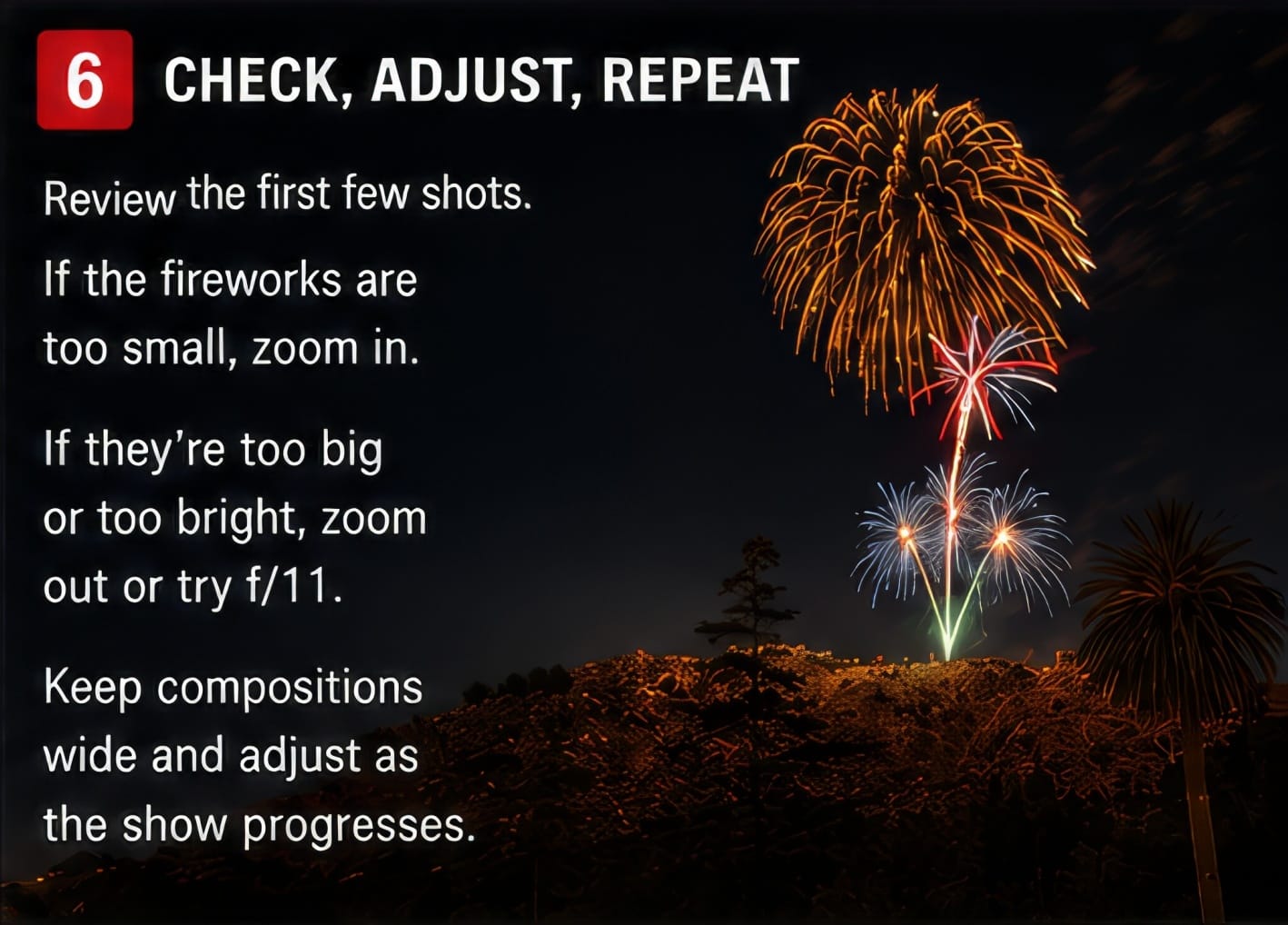
Check the first few shots. If the fireworks are too small, zoom in a little. Too tight, zoom out. Too bright, stop down to f/11. Too dim, open up to f/5.6. If the image is blurry, check focus and make sure the tripod is steady.
Do not spend the whole show staring at the back of the camera, but review enough to know your settings and framing are working.
Quick Camera Recipe
•Camera on tripod. Remote release attached.
•Start wider than you think.
•Manual focus before the show.
•Manual exposure: ISO 100, f/8, Bulb, white balance Auto.
•Open as the firework rises. Close after the trails fade.
•Review the first few shots.
•Zoom tighter only after you know the fireworks fit safely inside the frame.
The goal is not to come home with hundreds of pictures of bright smoke. The goal is to come home with a few photographs that show the fireworks, the place, and what it felt like to be there.
Come back for Part 2 next week: how to photograph fireworks with a smartphone. It is not the same as shooting with a traditional camera, but with the right approach it works surprisingly well.
Photos accompanying this series are actual fireworks photographs the author took at a past Mt. Rubidoux show — the same method described above, not a stock image or composite.