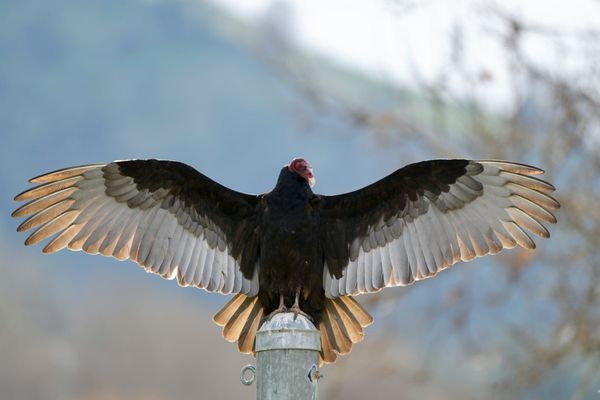

It’s that time of the year again. A bird that we largely forget from New Year’s Day until early fall returns to Southern California for a few months. Its less-than-comely featherless head and big beak are distinctive. So is its massive body. And there’s that distinctive call, or rather the fact that they don’t have a distinctive call — it only makes grunts and hisses because it lacks a syrinx, the special avian voice box. That’s right. 'Tis the season of the Turkey … Vulture.
Every fall Turkey Vultures abandon their northernmost summer homes for warmer ones to the south, as far away as Cape Horn. On the West Coast, they follow the Pacific Flyway, soaring over Southern California. At night, they stop to roost in large trees, from dozens to hundreds. Even though it was decades ago, I cannot forget watching at least 50 vultures silently drop into eucalyptus trees on UCR’s Picnic Hill at dusk. A rather spooky occurrence. My lab tech and accomplished birder, Janet Clegg, turned to me, deadpanning, “Norm, the Big One is coming”. Obviously, while they are harbingers of the season, Turkey Vultures are not prophets of seismic activity.
Vultures are large bald-headed birds of prey with weak, unhooked claws that almost exclusively eat the flesh of dead animals. They all have disease-resistant digestive systems so acidic that a nail would dissolve in their stomachs. Both the bald head and digestive system represent necessary adaptations for munching on microbe-infested rotting meat.
Vultures are a motley group, represented in every continent except Australia and Antarctica. Scientists have compared the genetics of the vultures of the New World to those of the Old World. The two groups are not at all closely related.
Old World vultures are essentially part of a large family that includes hawks and eagles. You can think of the Old World vultures as bald, weak-footed, carrion-eating eagles. Old World vultures have a syrinx and are capable of making a wide variety of vocalizations. As noted above, this organ is missing in New World vultures.
In contrast, New World vultures have some unique features of their own. The vast majority of bird species have little or no sense of smell. And that’s true for hawks, eagles and the Old World vultures. New World vultures in general, and Turkey Vultures, in particular, have an excellent sense of smell and use it to locate rotten flesh. Additionally, all New World vultures defecate on their legs, a process known as “urohidrosis”. Birds do not urinate separately from defecation; instead they produce rather sloppy whitish, highly acidic feces. (I know by experience, having been bombed by a pigeon in my youth.) Their waste nitrogen is white uric acid (not urea in the case of humans), which is largely insoluble in water. Urohidrosis is an apparent adaptation that cools the legs of vultures (birds have no sweat glands) and acts as a sanitizer/disinfectant for legs and feet which have been mucking about in bacterial rich rotting guts. The only other bird families that exhibit urohidrosis are the booby family and the stork family, leading some researchers to believe that the New World vultures and the storks have a common ancestor.
I stop to glance out the window. A Turkey Vulture sails by.
That reminds me to return to the topic at hand. Yes, Turkey Vultures are New World vultures, a family that includes a handful of other vultures and a couple of species of condors (think very large vultures). In the United States there are three members of the New World vulture family: Turkey Vulture, Black Vulture and California Condor. Black Vultures are not native to California. California Condors are California natives: endangered, exceptionally rare and deserving of their own story, for another day. If you see a free-living vulture in Riverside, in all probability, it is a Turkey Vulture.
Turkey Vultures (Cathartes aura = “the purifying breeze”!) range from southern Canada to the very tip of South America. While Southern California has its own permanent population of resident Turkey Vultures, the migration of Canadian birds in the fall through Southern California, including the Inland Empire, is notable. Turkey vultures spend most of their time soaring. They are easy to distinguish from other soaring large birds. They have two-toned wings that span 6 feet; the front half is dark and the trailing half is silvery. The head is tiny compared to the body. Without the aid of binoculars, the bird may be too far away to see the deep pink head. But if you are anywhere other than directly underneath the bird, the shallow V-shaped dihedral of the soaring wings should be apparent. Once aloft and soaring, a Turkey Vulture rarely flaps. This continuous gliding not only distinguishes it from hawks and eagles; it also distinguishes it from the related Black Vulture.
Turkey Vultures are efficient carrion scavengers and rarely kill their food. They have few natural enemies. Eggs and young chicks are vulnerable to mammals like opossums and raccoons. Dogs are capable of killing a Turkey Vulture. But the adult birds have an efficient and effective response: they can projectile vomit a stream of foul-smelling, highly acidic, semi-digested rotten meat. Humans rarely are a threat directly as this species is protected by the Migratory Bird Treaty Act. However, they are vulnerable to lead poisoning when they feed on carcasses that have been shot and abandoned by hunters. It is not considered an endangered species or a species of concern.
Like other birds and mammals, Turkey Vultures have specialized names for their groups. A group of resting and roosting Turkey Vultures is called a “committee”. A soaring collection, particularly while circling is called a “kettle” (as is true for other circling birds of prey). When feeding, the group is considered a “wake”. Birders have their own shorthand nickname for Turkey Vultures, “TVs”.
Whatever you call them, Turkey Vultures are remarkable birds. They are well-suited for their ecological niche. And just as sure as when candy corn, pumpkin spice, and that other turkey appear, the fall migration of Turkey Vultures means fall is here, and winter is on the way.
This month’s topic was suggested by Nathan Ellstrand.