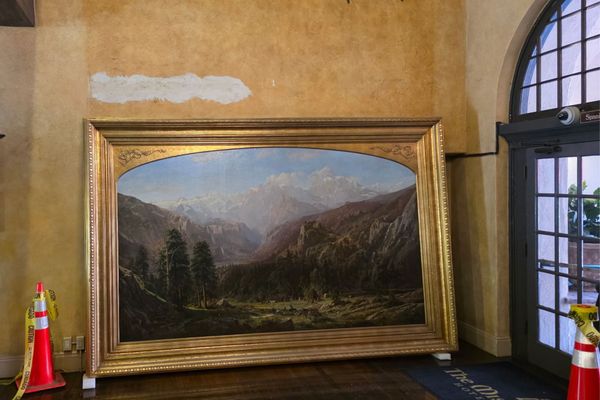

The removal of two valuable paintings from the Mission Inn Hotel and Spa on May 20 has raised three legal questions that may ultimately be resolved only in court. The paintings, "California Alps," an 1874 oil on canvas of the Sierra Nevada by William Keith, and "Charge Up San Juan Hill," an 1900 depiction of Theodore Roosevelt and the Rough Riders at the Battle of San Juan Hill by Russian artist Vasily Vereshchagin, had hung at the Inn for generations. Did the Inn's 1977 National Historic Landmark designation bind moveable objects to the property permanently? Was any enforceable contract regarding moveable objects executed in the 33 years between the 1992 sale to the Historical Mission Inn Corporation and the 2026 sale? And if an exclusionary clause exists in the current purchase agreement between outgoing owner Kelly Roberts and the San Manuel Investment Authority, an unincorporated governmental instrumentality of Yuhaaviatam of San Manuel Nation, would it be binding if the landmark designation had already tied those objects to the property?
The removals, widely covered in local and regional media, prompted an immediate public outcry. Dramatic photographs of "Charge Up San Juan Hill" being pulled from the wall circulated on social media and became the genesis of the public outcry that followed. Press-Enterprise columnist David Allen, who was in Riverside when a tip about the removals came in, wrote that a hotel employee ran to intercept him as he approached the California Lounge and told him photographs of the second painting were not wanted.
Roberts' attorney, Patrick O'Brien, declined to comment on the specifics of the transaction. In a written statement, O'Brien asserted that "the artwork and personal items in question are the lawful property of Kelly Roberts and her late husband, Duane Roberts," called allegations surrounding the removal "false and defamatory," and warned that the Roberts family would "take immediate legal action against any individual or entity that makes, publishes, or repeats these false allegations." The removals were carried out openly, in broad daylight, with a security guard present. Conversations with people familiar with the matter revealed a sense that the public nature of the removals and the directness of O'Brien's statement reflected a belief on the part of Roberts and her counsel that the legal foundation for her position was sound.
To understand why the legal picture is more complicated than the initial public reaction suggested, it is necessary to go back to the closing table.
The concern was not abstract. Ben Swig, who owned the Inn from 1956 to 1968, had sold off valuables during his tenure, a pattern that alarmed the community and contributed to the Redevelopment Agency's decision to purchase the property in 1976. The 1977 National Historic Landmark designation followed a year later. When Megna sat down at that closing table in 1992 the memory of what Swig had done was present in the room. The three-party agreement was in part a direct response to it. Whether the language Megna drafted was explicit enough to cover moveable objects is precisely the question that remains unresolved today.
At 4 a.m. on Christmas Eve, 1992, a team of negotiators finalized the sale of the Mission Inn. The transaction involved the City of Riverside Redevelopment Agency, the Mission Inn Foundation and the Historic Mission Inn Corporation, the entity through which Duane Roberts purchased the property from Chemical Bank. The closing had stretched across days. Tax implications required the sale to be completed before Dec. 31.
Ralph Megna was the Redevelopment Agency official who personally negotiated every aspect of the transaction. He drafted the three-party agreement himself, on a laptop computer, at the closing table. He has the wet-signed original. Megna said in an interview that the agreement was written specifically to address what he called the public equities in the collection, and that language requiring the buyer to retain ownership was intended to ensure the most significant artifacts would not be sold off and would stay with the hotel. He said he believes those restrictions are durable and has seen nothing to negate them.
Walter Parks, a Mission Inn Foundation member with direct knowledge of the 1992 transaction, offers a different account. Parks said the sales document itself did not cover moveable objects, that the question was deliberately deferred to expedite the process, and that Duane Roberts made a good faith commitment to negotiate the moveable items at a later date. Parks said a subsequent legal review commissioned by the Mission Inn Corporation concluded that moveable items remained the possession of the owner of the Inn. Parks said the city sat on its hands in the decades that followed, never returning to the table to formalize what Roberts had committed to negotiate. That account has been corroborated by other principals involved in the transaction.
The A List predates the Roberts sale. As the City of Riverside finalized the 1985 sale of the Inn to Carley Capital Group, it approached the Mission Inn Foundation to identify the hotel's most significant pieces. The resulting inventory of 254 items, known as the A List, runs to two categories: architectural and fixed elements, and moveable objects. Under the Carley purchase agreement, those items were prohibited from leaving the Inn. The list carried forward through the Carley bankruptcy and the subsequent sale to Roberts. Both "California Alps" and "Charge Up San Juan Hill" appear on it. So do the Taft Chair, the Goddess Pomona statue and "Arch Beach" by William Wendt, whose whereabouts are also unknown. The A List also includes Louis C. Tiffany stained glass windows, the Rayas Altar, the carillon, the Agua Mansa Bell, Gustav Stickley furniture, the Roycroft bookcase bearing the Raincross brand, and dozens of other objects that remain unaccounted for in any current public inventory.
Mike Marlatt served on the Mission Inn Foundation board in 1992 and later as its president. He said the Foundation was aware of the ambiguity and made an attempt to resolve it by asking Roberts to donate the moveable items into a trust, an arrangement that would have also provided tax benefits and relieved the hotel of curatorial costs. Roberts declined, saying he was not inclined to do anything adverse to the Inn.
Marlatt said the Foundation had also spent years and significant money curating, cleaning and restoring items in the collection, including more than $13,000 restoring the William Keith painting in the early 1980s, and that a for-profit entity accepting those services from a nonprofit implied at minimum a controlling interest on the Foundation's part. The argument was made, he said, but never formalized.
"I feel bad about that, to be honest with you," Marlatt said. "I didn't push harder."
Conversations with principals involved in the 1992 transaction revealed a shared sense that Roberts' good faith assurances were accepted in lieu of a formal agreement, and that as council members, Foundation leadership and city staff rotated over the following decades the unresolved question stayed on the back burner. The Redevelopment Agency that negotiated the original sale was dissolved in 2012.
The Mission Inn Foundation was evicted from the Inn in a 2024 lease dispute and now operates its museum from across the street. Its access to the property had been diminishing for several years prior to that eviction. Any inventory the Foundation holds reflects conditions from years before its removal from the building, and should be considered obsolete. The two paintings have drawn public attention, but the location and condition of other items on the August 1992 A List is also an open question. The full scope of what remains, what has been removed and what may have disappeared quietly over years of limited oversight will not be known until the new owners conduct a systematic accounting against the original document.
The people who were in the room in 1992 do not wholly agree on what the documents mean. Megna holds a firm position that the restrictions are durable. Kelly Roberts' current attorney, O'Brien has staked out an equally firm contrary view on behalf of his client. The 1977 landmark question has not been addressed publicly by any party with authority to answer it. A statement released by Yuhaaviatam early May did not reveal the terms of the current purchase.
What makes this dispute unusual is not that there are competing legal claims but that both positions are held by reputable principals with direct personal knowledge of the transaction and documentary evidence to support their accounts. Megna drafted the agreement and has the original. Parks was heavily involved with the Foundation and has knowledge of what was and was not resolved at closing. Marlatt led the Foundation through the period when resolution was most achievable. None of them wholly agree. That is not a recipe for a quick resolution. If the missing objects are ever returned to the Inn it will most likely be the result of a protracted legal process, a negotiated settlement, or a decision by the new owners to pursue the matter through the leverage available to them as the purchasing party. None of those outcomes is imminent.
This story does not make an attempt to adjudicate this matter, and a lengthy legal battle is in the formative stages.
"The notion that that painting is going to be back up on the wall in a couple weeks is completely naive," Marlatt said.
So Now What? Riverside Rallies Around the Mission Inn
The paintings are gone. The legal questions are real and the process of resolving them will be neither quick nor simple. What is equally real is something that did not exist the last time the Mission Inn changed hands: a city that knows what it has.
When Duane Roberts bought the Inn in December 1992 it was not at its bottom. Previous owners had spent years and significant money on restoration work, enough to make the property viable for sale. But most Riversiders carried the memory of the longer deterioration -- the flophouse years, the cheap apartments, the moldy novelty in a dingy city center -- and the gratitude for someone willing to see the restoration through to completion was genuine. The terms of the sale reflected it. The community that watched workers pull "Charge Up San Juan Hill" from the wall last week is a different community entirely. It grew up with the Inn as the glamorous center of downtown life, the setting for weddings and holiday celebrations and the Festival of Lights. It never had to earn the Inn back from ruin. It inherited the restored version and assumed, reasonably, that its grandeur was permanent and protected.
That assumption turned out to be wrong in ways that are now being worked out in public. But the depth of the response to the removals revealed something important. The Mission Inn's hold on Riverside's identity has never been broader or more deeply felt than it is right now. That is not nothing. That is the foundation everything else gets built on.
A significant part of that depth is the work of the Inn's docents, who have spent years building a public audience for the property's history through social media at a scale no tour could match. They created a distributed and emotionally invested community of people who know the stories behind the Taft Chair and the Rayas Altar and the Agua Mansa Bell not from a museum placard but from a post they shared with friends. When dramatic photographs of the removal hit social media that community was ready to receive them. The response was immediate and it was loud and it was grounded in genuine knowledge of what was at stake.
That community is now an asset. The Mission Inn Foundation, which operates its museum from across the street after a 2024 lease dispute ended its presence inside the building, has already signaled its readiness to engage with the new owners. The Old Riverside Foundation, the Friends of the Mission Inn, the Cultural Heritage Board and the broader network of preservation advocates who mobilized in the days after the removals represent an organized and knowledgeable constituency that the Yuhaaviatam of San Manuel Nation can draw on as they take stewardship of the property.
The Yuhaaviatam bring something to that relationship that the community has reason to feel good about. The San Manuel Investment Authority, an unincorporated governmental instrumentality of Yuhaaviatam of San Manuel Nation, has retained Pyramid Global Hospitality, a management company with more than 200 properties worldwide, to oversee day-to-day operations. They are not new to hospitality and they are not new to Riverside. The Nation describes itself as having deep ancestral ties to the Inland Empire and a commitment to remaining a productive partner in the region. In her statement accompanying the acquisition announcement, Chairwoman Lynn Valbuena said: "The Mission Inn is more than a landmark. It is a living institution – one that has witnessed more than a century of California history and has been woven into the lives of this region's families, including our own. We are honored to carry that legacy forward with the same dedication to maintaining its historic dignity and prominence."
The hope, widely shared among the organizations and individuals who have spent years advocating for the Inn's preservation, is that the new ownership will approach the Foundation, the docents and the broader community as partners in stewardship rather than as constituents to be managed. The legal questions surrounding the missing artifacts will proceed on their own timeline. In the meantime there is a hotel to run, a collection to inventory, relationships to build and a civic institution to tend.
There is also a lesson for the city in all of this. The unresolved question of the moveable objects was not the result of malice. It was the result of a good faith commitment made under time pressure in 1992 that was never followed up on, passed from administration to administration until nobody in the room remembered it was unresolved. Rotating staff, changing council members and shifting Foundation leadership created the conditions for a back burner item to stay there indefinitely. The cost of that inattention is now visible to everyone.
The new ownership transition is the moment to do what was not done in 1992. Whatever protections the community believes the collection deserves should be negotiated explicitly, in writing, with the new owners now. The goodwill is there. The opportunity is there. The organizations with the knowledge and the standing to engage in that negotiation are ready.
The Inn has survived fires, closures, bankruptcies and decades of uncertainty. It has always been saved by people who cared enough to act. That has not changed.
The San Manuel Investment Authority said as much directly. "While the specific terms and scope of the sale remain confidential, we look forward to partnering with the Mission Inn Foundation and the City to respectfully steward this historic landmark and preserve the artwork and artifacts at the property."
This is as much a story of the resolve of a city to protect a building that was almost too far gone, and the persistence of the docents to continue their education program on social media even after being displaced from the Inn. There will likely be more twists, turns, and surprises as the legal part of this story unfolds. It is certain that regardless of the outcome of the process to secure the removed artifacts, there is institutional and community support to assure the Inn remains the beating heart of Riverside culture.
Correction- Tues. June 2, 2026, 4:55 p.m.
An earlier version of this story stated that the Mission Inn Foundation assembled the A List in August 1992 at the request of Redevelopment Agency negotiator Ralph Megna. In fact, the A List was compiled for the 1985 sale of the Inn from the Redevelopment Agency to Carley Capital Group, not the 1992 Roberts transaction. The Gazette thanks a reader for bringing this to our attention.