

One hundred years ago on Sunday, June 13, 1926, Roman Warren, known as the Cowboy Aviator, performed a daring feat under the Mission Bridge over the Santa Ana River at the base of Mount Rubidoux. Recorded in photographs and in film, the bold flight has come to be part of Riverside's aviation lore.
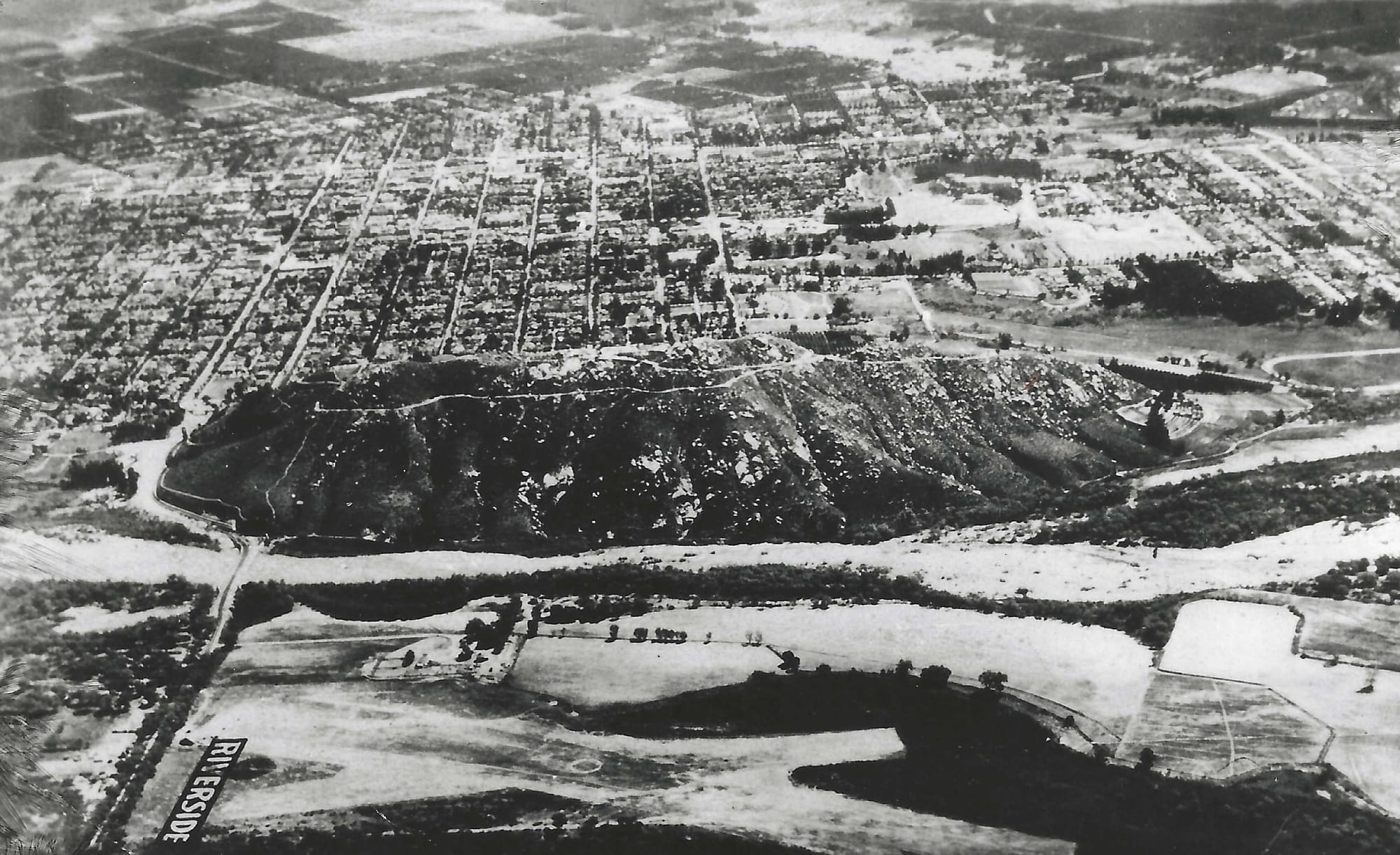
An early barnstorming pilot, Roman Warren, first made an emergency landing on an early field in Pennsylvania Avenue and Chicago Avenue in July of either 1922 or 1923, when he ran out of gas on a flight from Arizona to Los Angeles. Roman soon relocated to the area, and when the City of Riverside established the Riverside Airport (today's Flabob, not the Riverside Municipal Airport), he became its manager.
However, times were tough for many early pilots. Roman complained that he did not have enough money to even buy a hamburger. In a later interview, he reminisced, "In those days, you had to fly under a smaller bridge or over a bigger ocean to make a living, and my specialty was small bridges."
Warren decided that in order to draw attention to his flying, he would fly under the center span of the Santa Ana River Mission Bridge. The opening was only 16 feet high. The record at the time was set by a pilot who had flown under a 37-foot-high bridge. The newspapers generated interest in the event beforehand and announced that skeptics were wagering on whether the feat was possible.
The event was scheduled for June 13, 1926, at 9:30 on that Sunday morning. An estimated 5,000 people gathered on and near the bridge across the Santa Ana River that morning, many expecting a disaster to unfold. Police officers at the scene that day estimated that over 2,000 automobiles were jammed near the bridge at the base of Mt. Rubidoux. Through the 16-foot opening, Warren was attempting to fly his airplane, which measured 11 feet and 8 inches from the ground to the top of the wing.
The flight was delayed while photographers filmed Roman in his cowboy outfit, astride his Arabian horse, as he prepared for the flying stunt. News services and photographers were on hand to record this historical event with both cameras and moving pictures. Pathe, an international film company, installed a small camera powered by dry-cell batteries on Warren's plane to record the event from the air.
Finally, Roman Warren took off and performed stunts over the crowd. After stimulating the crowd, he flew up the river and soon returned. His flight was described the next day in the Daily Press:
From the north, he came directly toward the bridge, but just as he reached the structure, he zoomed upward over the heads of the surprised crowd. A few seconds later he made the second start, and this time, smoothly and seemingly without effort, he slipped through the arch, and was high in the heavens again before the crowd realized what had happened. A terrific cheer broke from the masses, and the crowd which had remained almost motionless the entire time Warren was in the air, broke into excited groups, all surging toward the field to congratulate the courageous flyer.
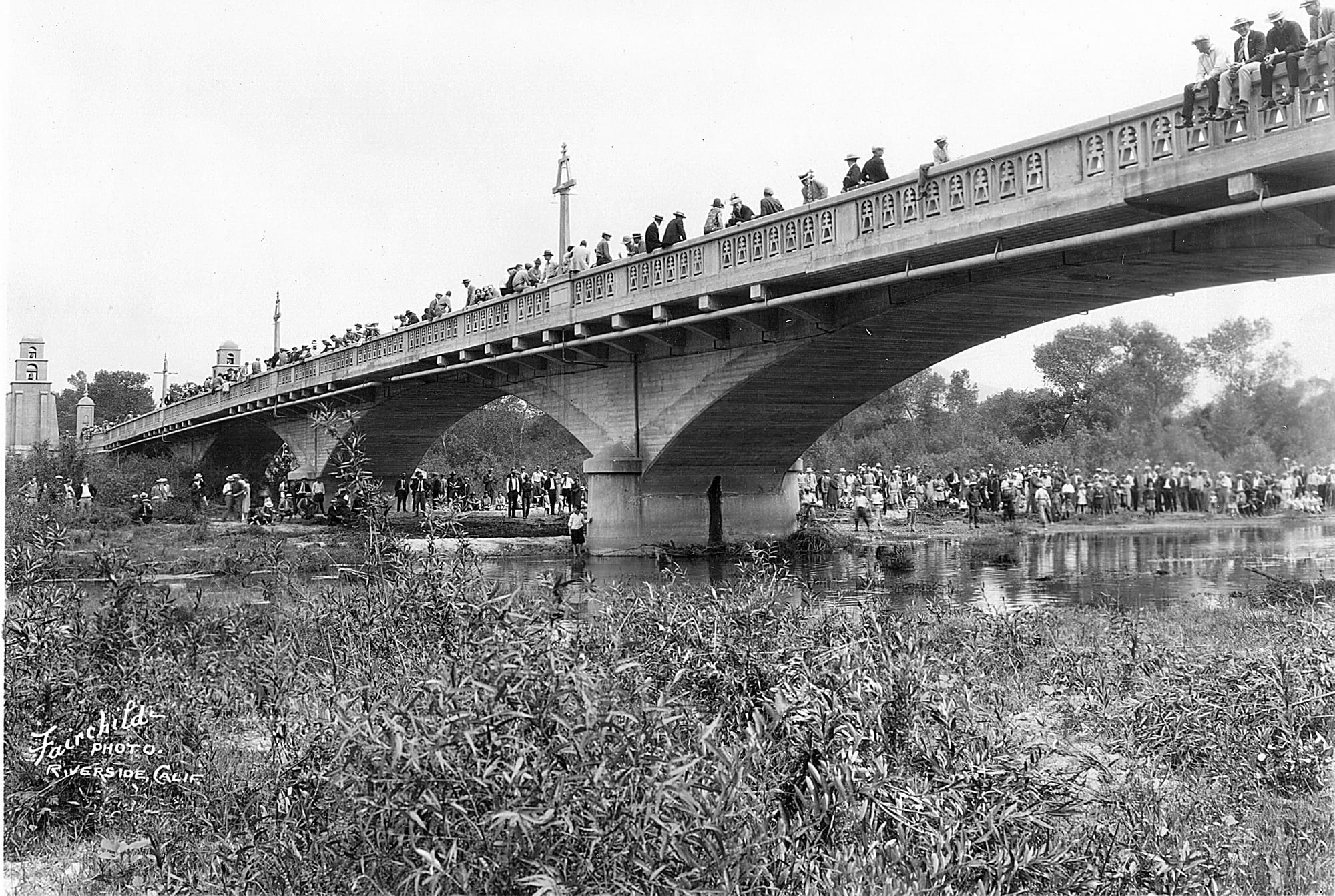
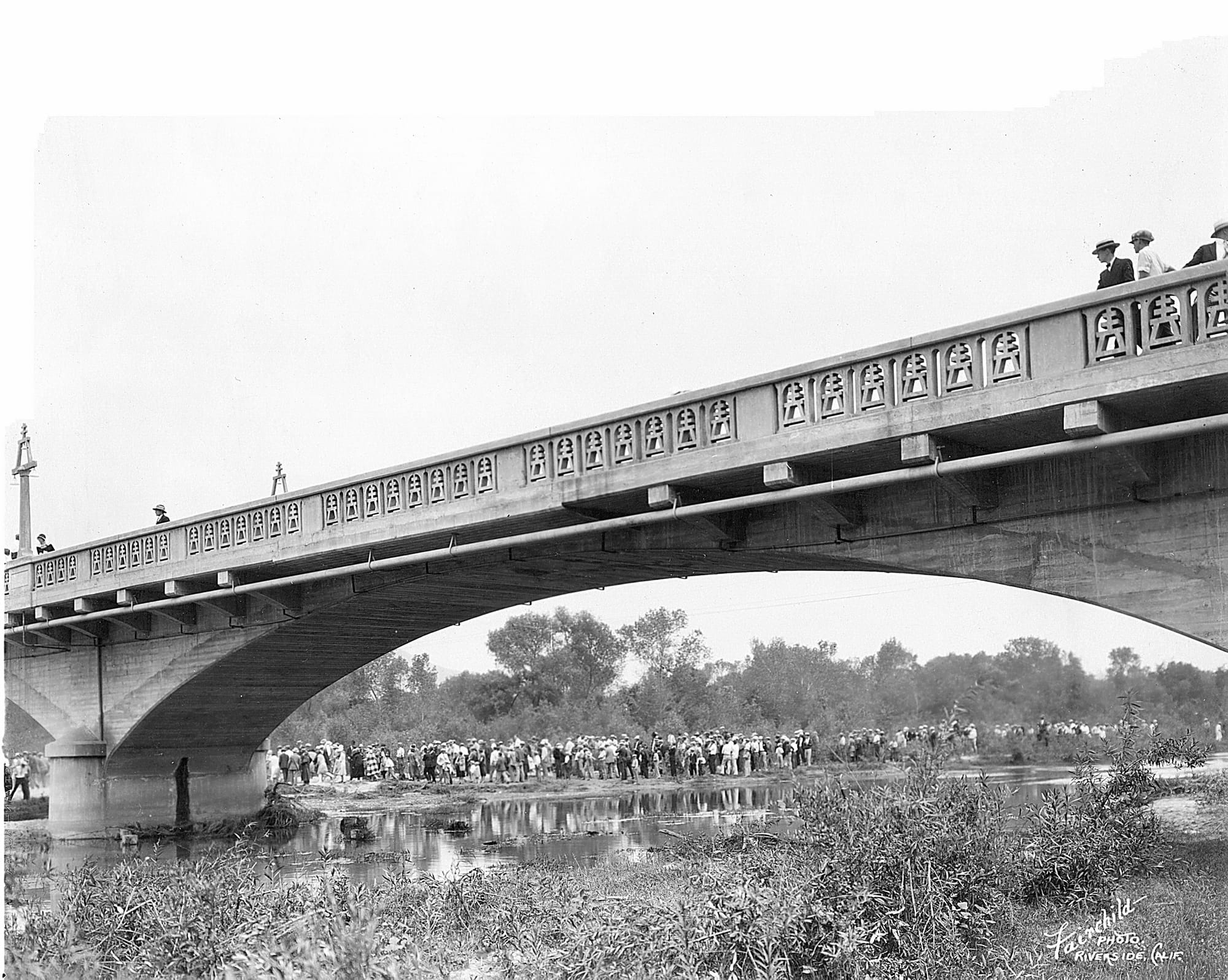
Having accomplished this daring feat at speeds of 125 miles per hour, Warren returned to the airport. He switched planes and offered to take passengers on rides. But on that day, he recounted he had no takers. Most were not ready to take a flight similar to what they had just witnessed.
That week, Roy Hunt showed films of the flight at his Rubidoux Theater Downtown Riverside. Newspapers publicized the event, and Roman soon had people coming to him for rides and lessons.
Two humorous ads in the following days played on the event and connected the flight to their products. Jack White ran an ad in the Riverside Enterprise:
World's famous aviator, who made spectacular flight Sunday morning at Mt. Rubidoux Bridge, Riverside, attributed his phenomenal success to the fact that four of Jack White's lighter than air waffles made the feat possible. Open from 6 a.m. to 12 p.m. Jack's Place, Rubidoux Bridge.
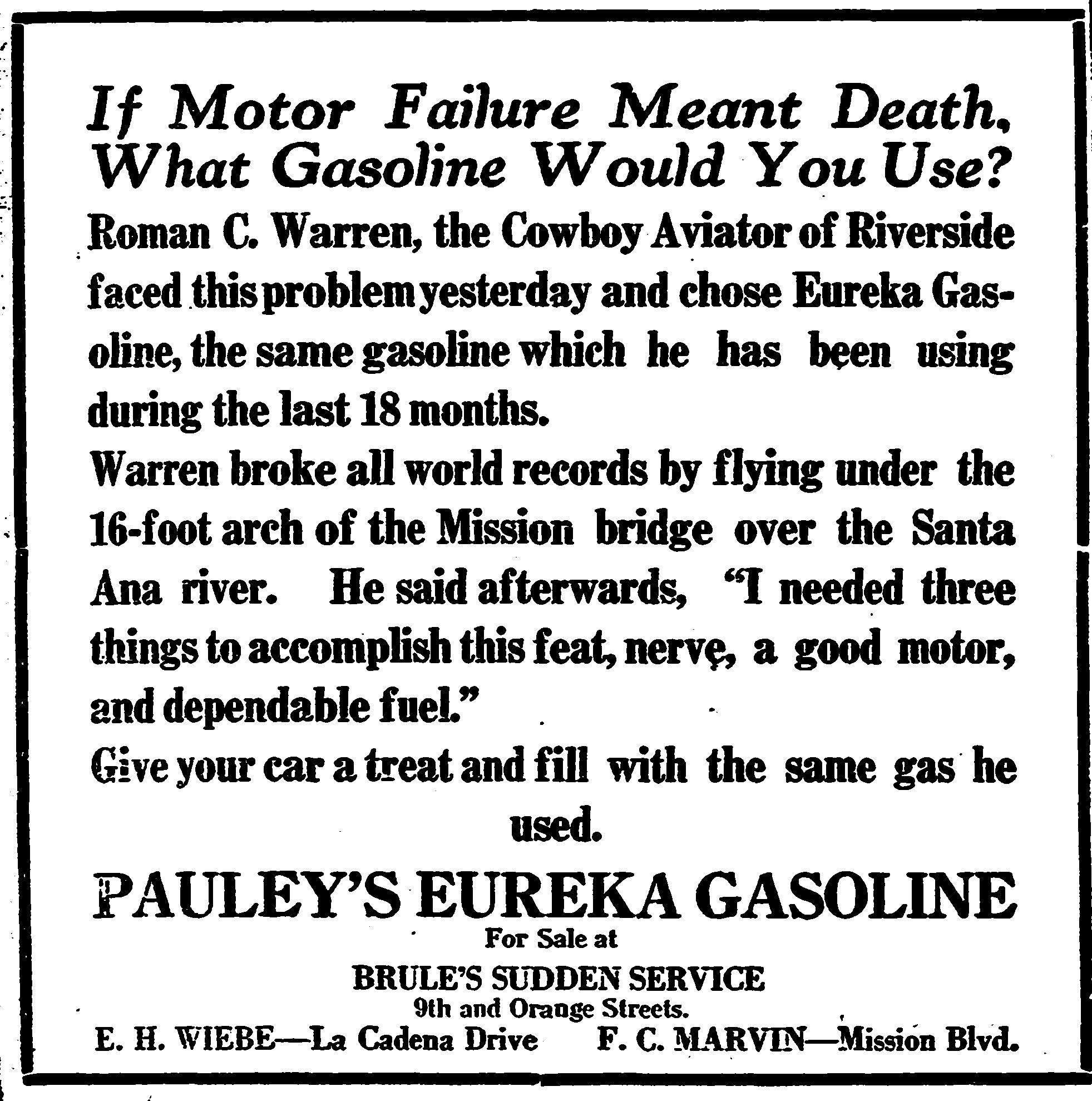
Pauley's Eureka Gasoline, which was sold at three local stations, published an ad with the headline "If Motor Failure Meant Death, What Gasoline Would You Use?" In the ad, they quoted Warren as saying, "I needed three things to accomplish this feat: nerve, a good motor, and dependable fuel."
Roman Warren was also able to build on this event in other ways, with invitations to air shows across the region. The Southern California Fair at the Riverside Fairgrounds, in 1927, hired Roman Warren to fly his Thomas-Morse Scout plane at 125 miles per hour under a wooden bridge built to replicate the Mission Bridge over the Santa Ana River. The Daily Press advertised these flights as a "Zoom for Life," as Roman had to do a quick pull-up after passing through the arch to avoid a pile of tires.
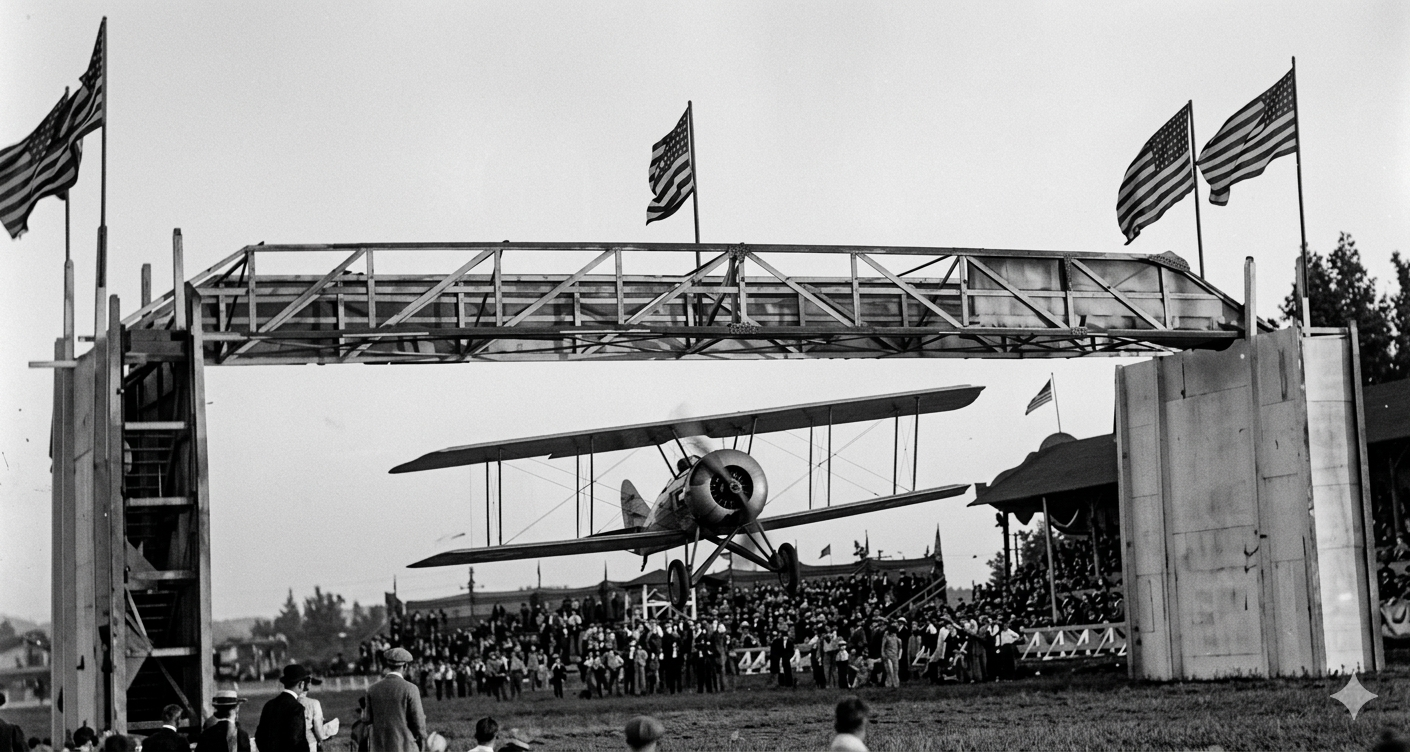
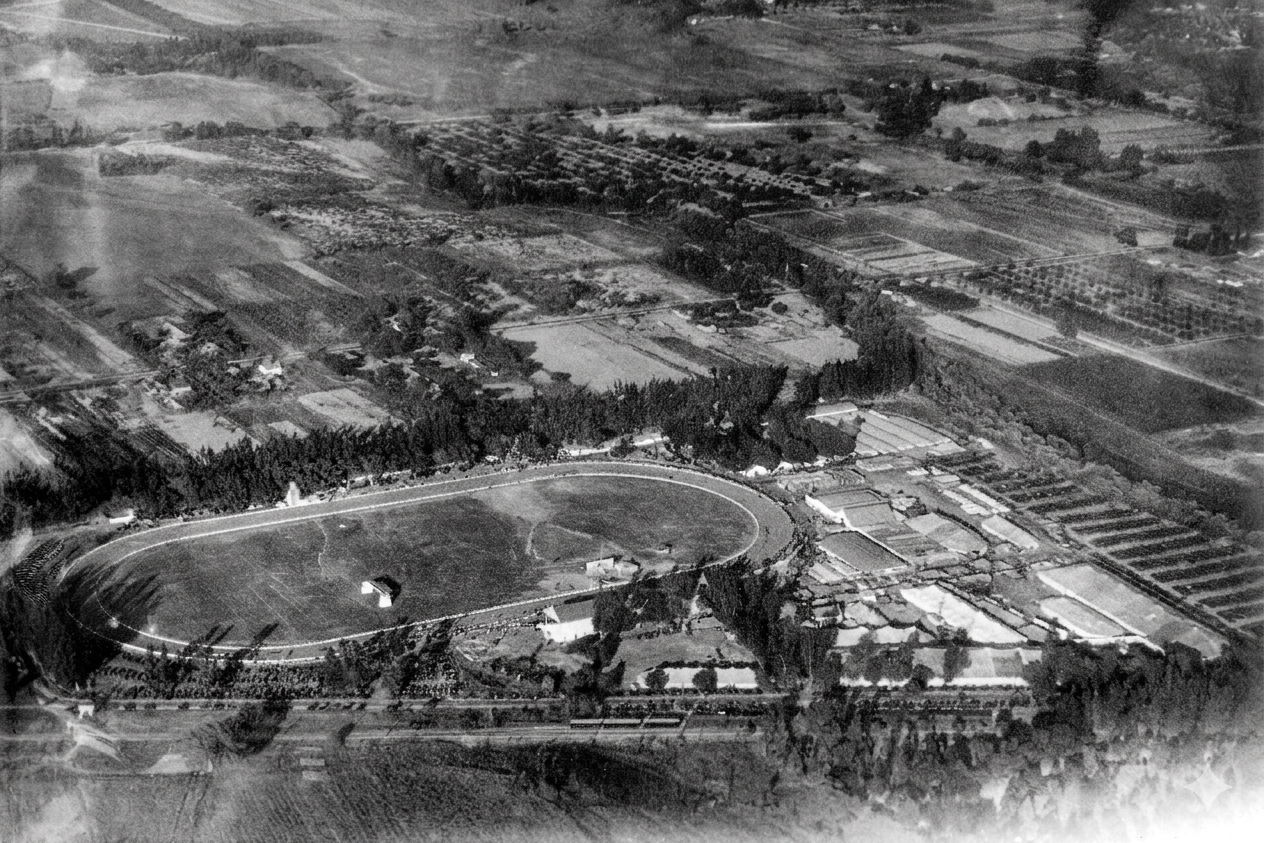
Warren repeated these flights in 1928, but that was the last year. He explained in a later interview with George Ringwald of the Press-Enterprise:
The last year I did it, on the final night of the fair, the north wind was blowing a hurricane here. But the people were in the grandstands for the act to go on. It was so rough, the ship almost got out of control, but by golly, I flew under that bridge — That's what they asked for. Just like the days of the gladiators. You know — thumbs down: They wanted to see blood." It was the last of the bridge flights for Warren. "I was disgusted with human nature," he said. "I didn't want to satisfy a morbid crowd again, I realized they didn't come to see a successful flight — they came to see a disaster."
One hundred years later, we recollect with awe the daring feats of early aviators such as Roman Warren, the Cowboy Aviator. His exploits live on in the history of our area.


