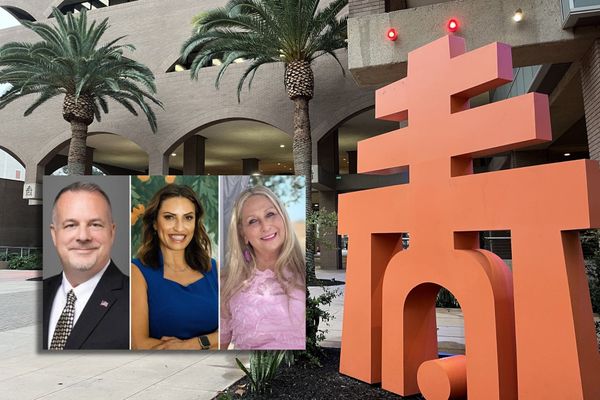

Getting students to school is one challenge -- making sure they leave with strong reading skills and a clear path to college or a career is another. In our third and final questionnaire, Riverside Unified School District board candidates explain how they would tackle these issues.
This round of questions asks Trustee Area 1 candidates to move from identifying problems to setting priorities: What would they do for campuses struggling with attendance? How would they help English learners keep progressing? And what improvements should families expect to see in two years?
Candidates Jinane Annous, Duffy Atkinson and incumbent Noemi Hernandez Alexander responded. Their answers follow.
1. Attendance
RUSD’s 2026 state Dashboard shows 15.8% chronic absenteeism in grades TK-8, with six schools at the two lowest performance ratings. What would you prioritize at those campuses, and what improvement would you expect in two years?
Jinane Annous: “My first priority would be to understand why students are missing school, especially at the six schools that need the most support. Sometimes families face challenges with transportation, health, or personal situations that affect attendance. I believe we need to listen to parents and work together to find solutions.
I would focus on better communication with families, reaching out early when students start missing school, and making sure students feel safe, supported, and welcome at school.
Over the next two years, I would like to see chronic absenteeism go down from 15.8% to around 12%. I believe that when schools and families work together, we can make a real difference.”
Duffy Atkinson: “RUSD reduced its districtwide chronic absenteeism rate to 15.8%. Attendance is one of the few student indicators every district tracks daily. That makes it one of the earliest places a student concern becomes visible, often weeks before it shows up in grades, discipline referrals, or a crisis.
The reasons for chronic absences are varied, such as disengagement, daily life barriers, and anxiety-driven school avoidance, and what works at one school site might not be effective at another. RUSD already deploys several strategies: ‘MTSS’ supports, data analysis, tiered interventions, and direct family outreach to address the issues keeping kids from school.
In two years, if RUSD reduced chronic absenteeism by 2.9% each year, we would see 770 chronically absent students measurably improving their attendance and RUSD would drop its overall absenteeism rate to 10%. THAT milestone would ‘move the needle’ on the Dashboard to GREEN on the performance scale (pre-pandemic level). That’s a win to celebrate.
I think a 6% improvement over 2 years is achievable… if RUSD is intentional and targeted in its improvement efforts. However, it is incumbent on staff to keep the board informed on what is working and what isn’t, so board level decisions support the highest impacting interventions.”
Noemi Hernandez Alexander: “While I am encouraged by the progress our school have made in reducing chronic absenteeism, 15.8% means too many students are still missing valuable instructional time. We have more work to do.
At our schools with the greatest needs, we are prioritizing an individualized, school-based, and a community informed approach. That begins with understanding why students are missing school. Attendance challenges are not the same across campuses or families. Transportation, health concerns, feeling disconnected, fear of ICE who are casing our most vulnerable neighborhoods and other barriers which require intentional solutions.
Our principals and district teams must use attendance data to identify patterns early, engage families, and coordinate targeted supports. We also need to examine which interventions are producing results and scale those practices across our district.
Over the next two years, I expect sustained reductions in chronic absenteeism, particularly at our highest-need schools. Our goal is not a better score on the Dashboard. It is to ensure more students are present, engaged, and learning.”
2. English learners
The English Learner Progress Indicator rose to 46.1% on the 2026 Dashboard. What would you change, if anything, to support continued progress?
Jinane Annous: “I’m glad to see that our English learners are making progress. It shows that something is working, and I believe we should continue building on that instead of making unnecessary changes.
I would support our teachers by making sure they have the tools and resources they need to help students learn English. I also believe students who need extra help should receive it early, before they fall further behind.
As a school board member, I would also encourage better communication with families, especially those who speak a different language at home.
During my work as a principal and as a director for EL population I have mastered the strategies to work with staff on delivering better strategies for our students. I am ready to personally work on this goal and to dedicate time and effort to replicate the same success for our schools
Over the next two years, I would like to see the progress indicator increase from 46.1% to at least 55%. Every child deserves the opportunity to succeed, no matter what language they speak at home.”
Duffy Atkinson: “RUSD English Learners improved by 2.4% on the indicator to reach 46.1%. It’s important to note that while there are four levels on the English Language Proficiency Assessment for California (ELPAC), there are six levels on the English Learner Progress Indicator (ELPI). It’s critical for RUSD to know where their English Learners are on each level on each metric to ensure no students are regressing.
Our State had one of the most stringent English proficiency-qualifying standards in the country which was a significant barrier for EL students. Now, with the adoption of CA Assembly Bill 2555, a substantive and much-anticipated legislative change, English Learners who score a level 4 on the summative ELPAC, or a 3 on the alternate ELPAC, will automatically be ‘reclassified’ with no further state-mandated hurdles necessary.
Why is this significant? Reclassification allows our former English Learners to have more class bandwidth for coursework and pathways options. This finally opens up doors for English Learners to access the academics that will set them up for future success.”
Noemi Hernandez Alexander: “I am so proud of our Multilingual learners. The improvement in English learner progress is encouraging, and it reflects the dedication of our students, educators, and families. Our newly established Multilingual Department is an important part of that effort.
At the same time, 46.1% tells us that we have a responsibility to accelerate progress for more students. We are strengthening our approach to multilingual education, including more intentional coordination of services and instructional practices. We are prioritizing high-quality designated and integrated English language development and providing teachers with the professional training and resources they need to support multilingual learners.
My hope and our goal are not just that our students become fluent in English, but that multilingual learners have full access to advanced academic opportunities, and college and career pathways.”
3. Achievement
Math results improved on the 2026 Dashboard, while English dropped 0.6 points, and both remain below the state standard. What would you prioritize, especially in English, and what gains would you expect in two years?
Jinane Annous: “It’s good to see improvement in math, but we still have work to do in both math and English. I’m especially concerned about reading and writing because these are skills students need throughout their education and everyday lives.
I believe we should focus on helping students develop strong reading skills at an early age. We also need to make sure students who are struggling get extra support and that teachers have the resources they need.
I would like to see more communication between teachers and parents so families know how their children are doing and how they can help at home. I would request regular reports to the board from principals to keep us abreast of strategies goals and achievements of regular basis
Over the next two years, I would like to see a 10- to 15-point improvement in both subjects on the state performance measure. We need to focus on what works and make sure every student has a fair chance to succeed.”
Duffy Atkinson: “Without a board-level examination of currently implemented professional practices done in conjunction with superintendent and cabinet input on historical program deployments, it’s difficult to determine and make recommendations on what is working or what needs support. As I’ve asserted before, Early Literacy is a must, and requires us to not take our foot off the pedal on K-3 reading instruction.
To move the needle in assessment outcomes, we must look to instructional practices, district-adopted instructional materials, agreed-upon essential learnings, and team-designed, short-cycle common formative assessments to evaluate if our students are receiving high quality ‘first-best’ instruction in all subjects, with a special focus on English Language Arts and Math.
When gaps emerge, we must respond with timely, targeted interventions, differentiated instruction, and teacher supports that have functional impact. Progress reviews should guide adjustments while the Board monitors metrics to ensure improvement lands for students who need it most.
To put this in perspective, if ELA scores improved 3 points per year over the next two years, RUSD would move to GREEN on the California Dashboard. In Math, RUSD would need to improve 11.3 points per year over the next two years to get the same result. There’s work to be done.”
Noemi Hernandez Alexander: “I am encouraged by the improvement in math, but our overall achievement levels are not yet where they need to be. The slight decline in English language arts reinforces the importance of instructional improvement efforts.
Our first strategic priority is accelerating student outcomes, and that begins with strong, consistent Tier 1 instruction in every classroom. We are strengthening professional learning communities, the use of formative assessments, and we are asking teachers to identify and respond to student learning needs.”
4. College and career
RUSD’s own dashboard shows English learners and low-income students are less likely than other seniors to complete UC/CSU-required courses. How would you close those gaps while strengthening career pathways for students pursuing other options?
Jinane Annous: “I believe every student deserves the same opportunities, regardless of their background or family income. We need to make sure English learners and low-income students have access to the classes and support they need to qualify for UC and CSU schools.
I would like to see schools provide more guidance to students and families early on, so they understand what classes are required and what options are available after graduation.
At the same time, I believe college is not the only path to success. Some students may want to learn a trade, attend community college, or enter the workforce. We should support those choices by expanding career training, internships, and partnerships with local businesses.
Over the next two years, I would like to see at least a 10-percentage-point increase in UC/CSU course completion among English learners and low-income students, along with more career opportunities for all students.
My goal is simple: every student should leave school prepared for their future, whatever path they choose.”
Duffy Atkinson: “Academic counselors conducting transcript analyses would determine if our English Learners and Low-Income students may be eligible to take more A-G courses. Failing to reclassify as fluent English proficient or failing courses makes it almost impossible for students to take the required A-G courses for CSU/UC admission. As mentioned in my earlier response about the importance of EL reclassification, there is more flexibility in a student’s academic schedule if they aren’t required to take supplemental courses such as English Language Development (ELD) that may be preventing them from taking A-G aligned coursework, especially electives.
For EL/LI students, transcript analysis also uncovers students failing classes. If so, have they had the option to recover credits? If we have a system to identify students failing early in the term, how rapidly are we responding with the necessary interventions to prevent them from continuing on that path and failing the course? If students have to re-take a class, this seriously limits their options to ever take the required A-G coursework for eligibility to enter CSU/UC campuses.
My question is why the teacher’s union is backing a candidate who has never identified this as a priority in 4 years on the board?”
Noemi Hernandez Alexander: “Whether a student chooses a four-year university, community college, career and technical education, an apprenticeship, military service, or direct entry into the workforce, our responsibility is to ensure that students graduate prepared and with real choices.
We have made some significant progress on the College/Career Indicator (CCI) with 62.3% of our graduates identified as prepared – a 7.4 percentage point increase – from the previous year. This progress reflects our ongoing efforts to strengthen college and career readiness while recognizing that more work remains to ensure every student is equipped with the support they need to succeed. This is why programs like Legacy are important.
We are strengthening our approach to college and career readiness through earlier academic planning, intentional monitoring of A-G progress, expanded dual enrollment opportunities, and stronger alignment between academic coursework and career pathways.”