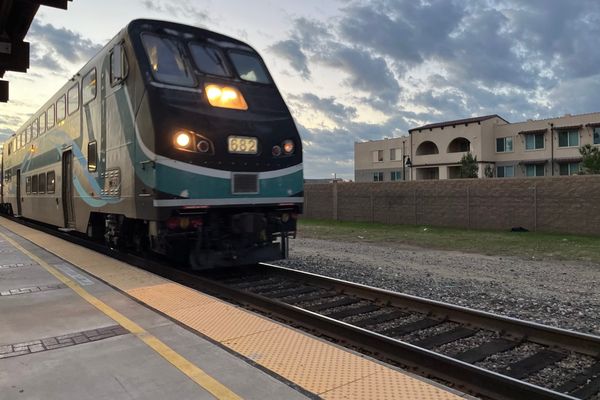
Metrolink is facing imminent service cuts as soon as November 16th. These cuts would cut weekday service by 22% on the IE/OC line, 14% on the 91/Perris Valley Line, and 36% on the San Bernardino Line. These cuts will make it harder to ride, reduce ridership, and potentially beget more cuts next year, threatening Metrolink’s very future.
Why is this happening? While Metrolink is suffering from rising costs due to inflation and ridership that, while steadily growing, is less than before the pandemic, the precipitating factor behind Metrolink’s budget crisis and service cuts was Orange County’s decision in early 2026 to reduce their operating support for Metrolink. Metrolink doesn’t have a dedicated funding source and relies on cooperation from its 5 member counties - cooperation that is now falling apart, at the expense of riders.
If you are one of the 250,000+ weekly riders who use Metrolink as part of your commute or as a means to travel around the greater Los Angeles area, you are about to find out that your travel arrangements are going to get much more difficult.
For Metrolink riders like myself, Metrolink is an important connection for school, work, and leisure. In my case, Metrolink saves two to three hours every day commuting to where I need to go. I don’t drive and, for several reasons, including medical reasons, cannot drive. What’s worse, however, is that for many, there simply will be no alternative–commuters will be forced to either drive or not travel.
The dreaded “alternate transportation will not be provided” announcement made increasingly regular at Metrolink platforms is a stark reminder that Metrolink has no backup plans for if service is interrupted, whether because of mechanical issues with their current equipment or because of coastal erosion and fire blocking the Surfline.
It is also, however, a warning-a warning that there really are no alternatives. Metrolink is one of the only public transportation services that crosses county lines with speeds that make it convenient. The effects of these cuts are therefore going to be disproportionate in areas where such services are the most important and for which there are the fewest possible options.
Riverside County is an especially egregious example. Geographic constraints and jurisdictional ones mean that RTA, the public transportation operator for Riverside County terminates services in San Bernardino and Orange Counties due to archaic requirements for JPAs in the SoCal area for cross-county services.
I regularly commute to Los Angeles as part of my work and research on the public transportation network in Southern California. I am a graduate student at UCR who researches the history of the public transportation network of Southern California. I am intimately familiar with the current state of public transit in SoCal.
The 91/PV line, servicing both Riverside and Orange Counties, is the most direct route. There are currently only two public transit alternatives for service to Los Angeles on this line. The first of these is RTA’s 200 bus to Disneyland. From there, riders then make a connection with LA Metro's 460 to Downtown Los Angeles. Despite them being neighboring counties, the 460 is the only LA Metro service that enters Orange County. The second is RTA’s 204 bus to Montclair, which allows for a connection to Foothill Transit’s Silver Streak to Downtown Los Angeles.
For riders of the IEOC Line from Riverside, the 200 is the only alternative to Orange County. There are no Orange County buses that connect with San Diego, nor is there any RTA bus that does so. The IEOC and the Surfliner are the only public transportation options available for connections with San Diego county.
From a rider experience perspective, these buses are long, uncomfortable, and crowded. While they are still essential services, they are far from appropriate for servicing an area as populous and as large as Southern California.
On a good day, using these alternatives can take upwards of three hours. Because they use the freeway and share the roads with traffic, congestion can cause delays, adding another one or two hours. There was once a historic direct bus route from Los Angeles to Riverside, but this service no longer exists, and it isn’t because of Metrolink as one might expect, but because of problems with the governance model in Southern California.
Since I live in Corona, you can also usually add another hour to my commute, because neither the RTA 200 nor the RTA 204 service Corona. Corona’s two Metrolink stations, Corona North Main and Corona West, do not have alternative services to Orange or Los Angeles Counties by bus. Instead, I need to take the RTA’s 1, for upwards of an hour to Riverside before I can connect with these services. Cuts to Metrolink, as well as the inflexibility of RTA’s own schedules on the 204, and the inaccessibility of the 200, make these exhausting and unrealistic choices. The alternative then is to simply not conduct regular research in LA.
What are the solutions then? The short-term solution is to push the counties to return funding to Metrolink necessary to maintain pre-March service levels, when service cuts began for mechanical reasons.
The long-term solution is to enact governance reform that provides a permanent funding mechanism for Metrolink. Currently, the Metrolink JPA gives full discretion to the county commissions who are party to the Metrolink Governing Board, allowing them to make changes without input from other member agencies. This is not sustainable for Metrolink, which is left with questions about its budget from year to year, and causes delays in budget-making decisions and schedules.
Governance reform would also allow for a new authority that can implement new transportation services that cross county lines. Rather than limit Metrolink to rail, why not create a regional transportation authority that can also operate other forms of transit, including buses that can service areas not currently serviced by rail? Similarly, it makes sense to combine the authority of the Surfliner with Metrolink, so that they can be coordinated as a single entity that combines planning and transportation needs for different passenger needs.


