
Welcome back, you patient creatives! Last week, we turned waiting in line into a temporary community with durable artistic practices. Did you invent a snack suitable for the slowest check out line of all time? Perhaps you identified the real reason we’re all standing around in an orderly fashion. Whatever moved you, I hope you arrived somewhere worth the wait.
This week, our exploration of social customs continues with the act of borrowing something from another person. Consider the amount of information packed into “Can I borrow…?” We might mean a pen for a minute, a ladder for a weekend chore, or a few bucks until payday.
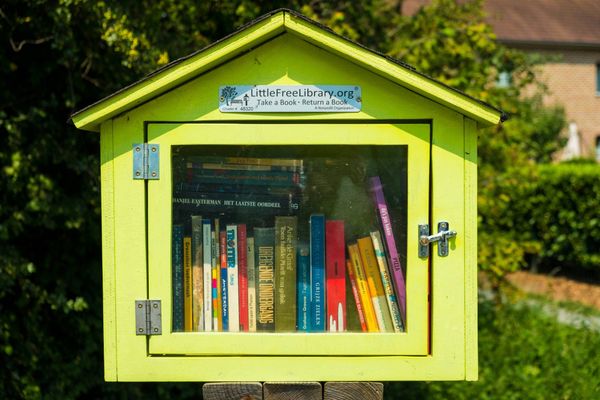
Borrowing from a co-operative or a library can feel like winning. You get access to something interesting without having to buy it or figure out long-term storage options. Libraries around the country make borrowing pleasantly straightforward; our local branches even lend out non book items like telescopes, pickleball equipment, and even a ukulele kit. Plus, when you don’t return them on time, or in less-than-mint condition, they’re very understanding.
The same isn’t true when we borrow from friends. Return a book to a friend with a folded corner or torn cover jacket and that may be the last time you’re invited to book club! Taking too long to pay back that interest free friend loan might not hit your credit rating, but it will impact your social standing.
Making art involves another form of borrowing. We try techniques we learn from a video; we see a painting and have a desire to share our vision with the world as well. Assemblage artists like me delight in borrowing ideas and objects and combining them in novel ways.
I want borrowing to encourage human expression on both sides of the transaction. There is pleasure in having something useful to share, and pleasure in discovering we do not have to own it all to do it all. Loan your creative process a few minutes of your attention with one or more of these nudges. No collateral required:
1. Terms of Enjoyment: Write a silly contract to borrow an intangible: a friend’s confidence, a cat’s meow, a toddler’s singular focus on “now.” State what you will use it for, when you will return it, and what conditions count as normal wear.
2. You Are Appreciated: Choose something you really have borrowed and make a small card to accompany its return. Thank you notes written by hand can definitely increase your chances of borrowing something again. I think this even works on librarians. Bonus points if you can write in cursive.
3. Renewed Appreciation: Write a three-sentence explanation or cartoon panel for why you haven’t returned something and it’s totally not your fault. Blame the weather, blame your parents, or blame it on “the game.” Just don’t blame yourself.
4. Scene Stealer: Capture something out of the focus as part of a photograph: a distant roofline or a cloud. Add found objects to the foreground to make your viewer wonder what might happen next. Alternatively, take pictures of people taking pictures.
5. Legalese: Borrow instructions from a recipe, washing label, or product manual and make a found/borrowed poem. Choose words based on “flow” or some other ephemeral quality; go beyond simple instruction and drop some life lessons on that open mike.
Borrowing gives us a chance to try something before making it a permanent part of our lives. Sometimes we return the object and keep a skill, a memory, or a new interest. I’m usually grateful I can acquire those things without putting down any of my own money. This week, let something borrowed help you make something you could not have created alone.
This column was written with help from ChatGPT, grateful to the humans helping it borrow our every thought, word, and image.