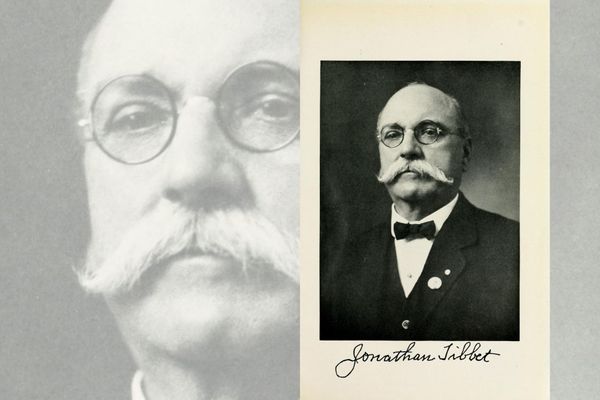
Jonathan Tibbet, born Jan. 5, 1856, on a ranch in San Gabriel is described in early literature as a native son of the Golden West. His father, a successful cattle rancher acquired thousands of acres of land near the San Gabriel Mission, and it included seven Native American villages. During Jonathan's adolescence his exposure to tribal communities and their ways became commonplace. He learned several languages and dialects and spoke fluent Spanish. Native people worked for his father as ranch hands, servants in the home and in some cases were friends to the family. Jonathan Tibbet Sr. paid his workers double the going salary thus gaining their trust and respect. His upbringing instilled unto a young Jonathan a keen understanding of the injustices involved in the management of Indians and Indian affairs.
He not only learned the language but also the Indian point of view, and through the Indian ceremonies he was made chief a number of times and to the Indians is known as "Chief Buffalo Heart," according to John Brown's History of San Bernardino and Riverside Counties.
As a young man, Mr. Tibbet spent the 1870s and 80s in Arizona as a civilian Indian scout, Chief of Scouts and U.S. deputy marshal. During this time, Mr. Tibbet remained sympathetic to Indian people and was said to have saved many lives. Although described as a large frontiersman, commanding and poised, his nature was friendly. In 1891, when Mr. Tibbet settled in California, he ran a general store and hotel in Menifee Valley. Once in Riverside, he established a broker's office that dealt in the buying, selling and developing of real estate. Due to the nature of his business doings, by 1912, Tibbet owned three ranches in Riverside County equaling over three-hundred acres combined, a bee ranch in the white sage country, more than forty lots, and several houses in Riverside. His capital also enlisted commercial enterprises, banks, city property in Los Angeles and the county, and a summer home in Orange County, according to Brown. Clearly a man of responsible character that attributed his success to never taking a drink, gambling or signing a note. He belonged to various organizations including a member of San Bernardino and Riverside Pioneers, a member of the Los Angeles Chamber of Commerce, and an honorary member of Los Angeles County Pioneers.
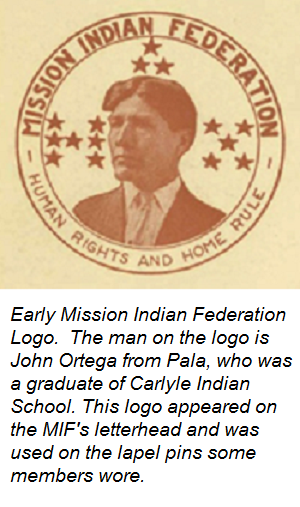
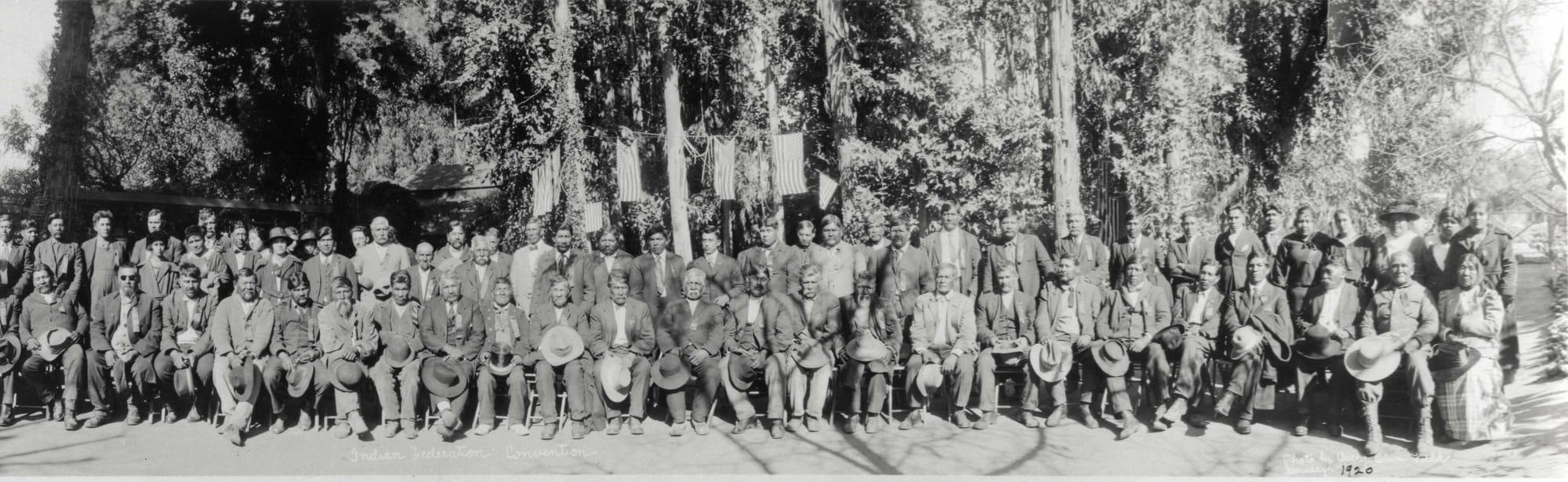
While enjoying the Riverside County Fair in October 1919, Mr. Tibbet was approached by Native friends of his and his father. The conversation, while brief, led to more than a dozen mostly Cahuilla and Serrano captains, arriving at his Riverside home on Prospect Ave. to discuss the oppressive control by government agents over the Native population. They believed Natives would never be treated as full citizens if the Bureau of Indian Affairs (BIA) continued to oppress and exploit them. Based on this first meeting came the political organization known as the Mission Indian Federation or MIF. At this time, Native people were not considered United States citizens which they saw as an injustice. The first group comprised of Southern California tribes both federally recognized and non-federally recognized with a common goal: the dissolution of the BIA and its associated subsidiaries, the right for tribes to own their reservation lands, and the right to self-determination enjoyed by all American citizens, according to the Pechanga Band of Indians. After all, Native people, not just in Southern California, but across the United States, proved their patriotism and love of country by answering the call of its government to fight in World War I. So why then, were they not free to govern themselves, and free to enjoy the same rights and privileges as the white races? Brown writes.
Mr. Tibbet's support of Native welfare came in many forms. Hosting semi-annual MIF conventions at his Riverside home, traveling to St. Louis, Missouri to speak on behalf of Southern California Indians and their desires to eliminate the Indian agency system and visiting other tribal nations along the way in hopes of recruiting more members. One report puts Mr. Tibbet and a group of Native men in Thermal, CA where they allegedly chased off white farm workers from Cahuilla territory. After the creation of MIF, members felt emboldened to assert authority over their reservations. They appointed their own political representatives including a chief of police, captains, judges and deputies, all of which challenged federal authority. Mr. Tibbet helped organize the Mission Indian Federation, never voted with the tribes and only acted as counselor on ideas they advanced themselves, according to Brown.
The government and Indian Bureau police blamed Tibbet, calling his influence the cause of mistrust and insubordination among tribal communities. However, it can be said that he did what was asked of him and his intentions were always for the betterment of his friends.
In the Spring of 1921, an indictment was issued for Mr. Tibbet and over 50 MIF members claiming they conspired to oppress the rights guaranteed by the United States Constitution and the alienation of the confidence of the Indians in the Government. All charges except those against Mr. Tibbet were dismissed. They accused him of "Bolshevistic" actions for self-gain.
Vindication came in 1924 with an acquittal and the passage of the Indian Citizenship Act, which granted all Native Americans in the U.S. full citizenship without affecting Native property rights or tribal status, thus fulfilling a goal of the Mission Indian Federation. Had he lived to be 97, Mr. Tibbet would have witnessed another stated goal come to fruition for the Federation. In the Summer of 1953, Congress passed Concurrent Resolution 108 and Public Law 280, which ended their status as wards of the United States and reduced the influence of the Bureau of Indian Affairs — though the policy's long-term effects on tribal sovereignty proved deeply damaging to many nations.
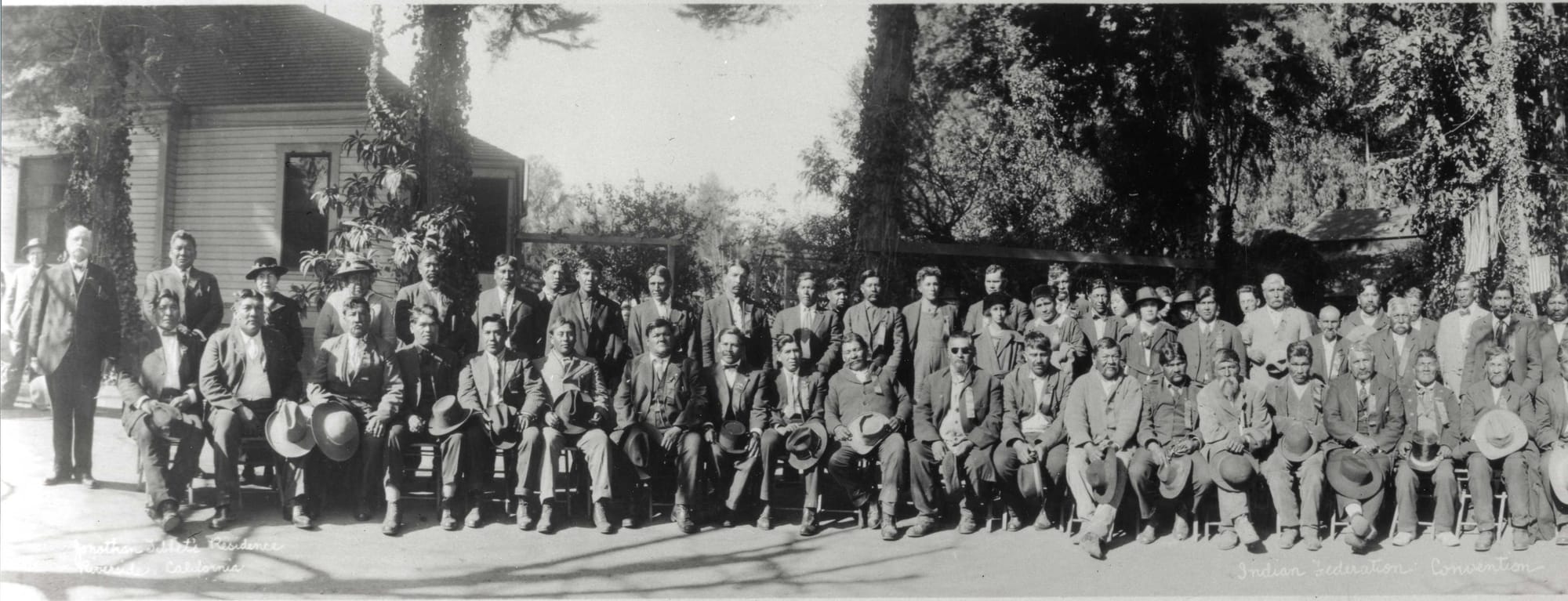
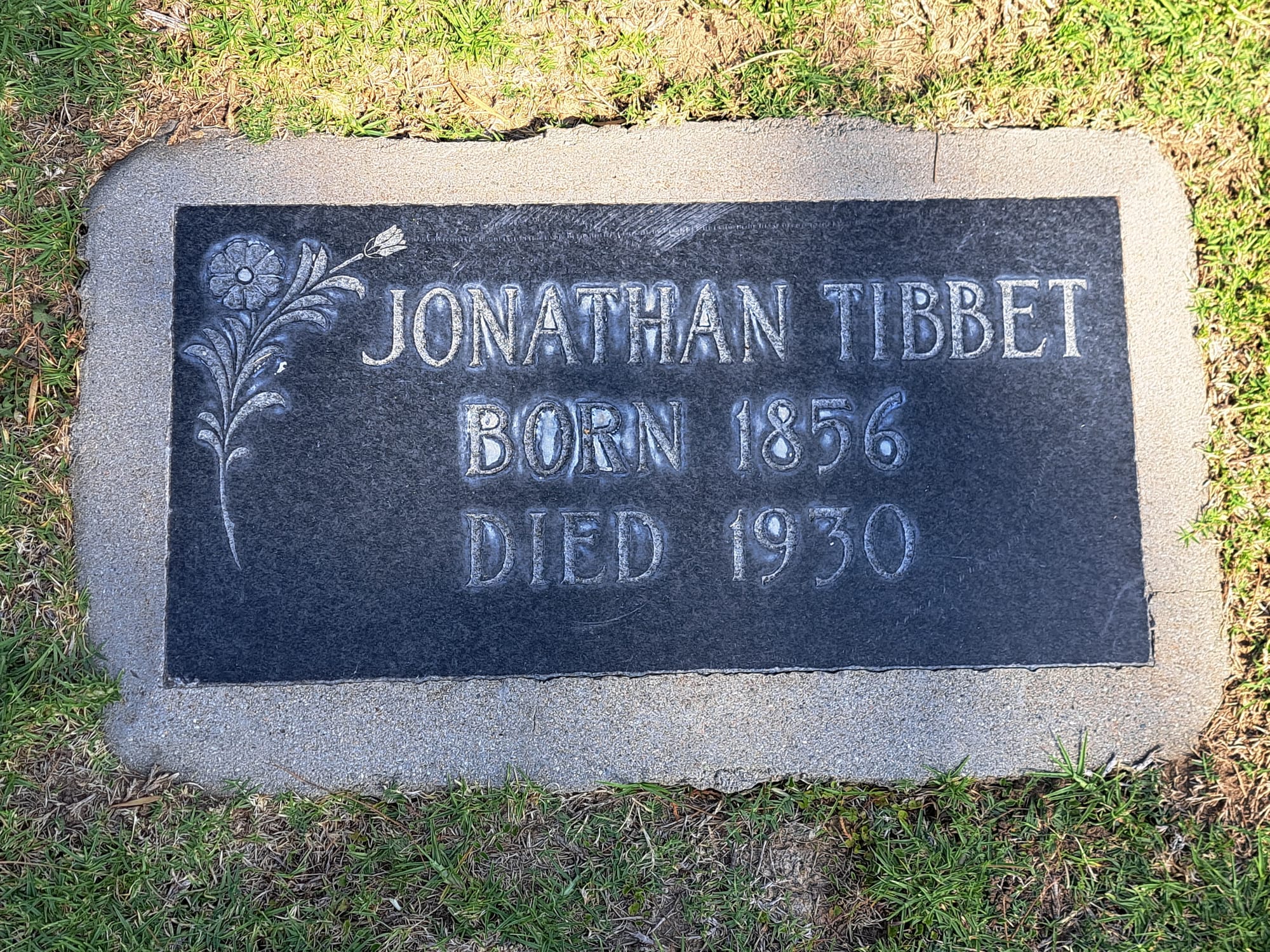
Mr. Tibbet passed away April 22, 1930, coincidently amid the Federation's Spring gathering at his Riverside home, he was 74. Within days, he was laid to rest at Evergreen Memorial Park. All eight of his pallbearers were Native. In his lifetime Jonathan Tibbet achieved undoubted commercial success, good fortune, and his share of scandal. Regardless of his achievements, his legacy remains that of the "Grand White Counselor," a non-Indian founder of the Mission Indian Federation. An ally to Native people across many tribes and many homelands during a time of uncertain progress. In 1932, Adam Castillo of Soboba, President of MIF had this to say:
"We could not speak effectively as Indians and had to get a white man who was friendly to us to do some of the talking. Our old people found a white man living in Riverside who was willing to take up our cause. His name was Mr. Tibbet. We now know that we have heard a lot of bad reports about him from the white people. But perhaps when his story is all known there will be a lot of good that can be said about him too... He was our friend."
— Adam Castillo, Soboba, President of MIF, 1932 (Fact-Finding Study of Social and Economic Conditions of Indians of San Diego County, pg. 54)