

Riverside has done America 250 before. It just called itself a Bicentennial city.
Fifty years ago, Riverside won official designation as an American Bicentennial city — a status the city competed for and that produced a wave of civic and cultural projects still embedded across town. As the country approaches its 250th birthday, the city is once again leaning into local history to mark a national milestone.
That same instinct shaped this year's Vintage Home Tour.
On Saturday, May 16, the Old Riverside Foundation will open the doors of five private homes — built between 1924 and 1955 — for its 33rd annual self-guided tour. The theme, "Age is a Work of Art," uses the semiquincentennial as a frame for three decades of American life.
The phrase came to Nancy Parrish — the foundation's secretary and Vintage Home Tour committee chair — while she was listening to a podcast.
"It came from Polish poet Stanislaw Jerzy Lec," Parrish said. "Youth is the gift of nature, but age is a work of art."
For Parrish, that line cuts to what historic preservation argues every day. "Beauty is often recognized in the young, or what is new and contemporary," she said. "But what we become with age might be discounted or unrecognized — but it truly is what has passed the test of time. I view vintage houses and neighborhoods in the same way."
The America 250 pairing came together after Falcone, whose ward includes most of this year's featured homes, reached out to ORF about coordinating. He has been borrowing from Riverside's 1976 Bicentennial playbook for the broader semiquincentennial push. "Historic preservation was founded initially with an emphasis on patriotism," Parrish said. "So this theme suits us perfectly."
The tour spans 1924 to 1955 — three of the homes from what Parrish calls the "revival period," and two on the front edge of the midcentury.
The earliest three (1924, 1925 and 1931) include two Spanish Colonial Revivals and a third that, in Parrish's reading, leans more Mediterranean Revival. The 1940 home is by Herman Ruhnau, the prolific Riverside architect, who described its style simply as "American." The youngest of the five, a 1955 Ranch, is described by its current owner as "midcentury modest."
For Parrish, each house is a chapter in a larger story.
"One of the central themes of the American story is that of western expansion — the push from back east and the Midwest to come to California seeking a better life," Parrish said. "People were looking to find a healthier climate and opportunities to reinvent themselves. That element of imagination drove the creation of the architectural styles that Riverside is so well known for."
For the past 22 years, the home selection has been Parrish's project. Last year's tour featured houses spanning Victorian to midcentury.
"I've chosen the homes by driving around the city and writing down those that I'd personally like to see on the inside," she said. "I research who owns each one and then send them a letter telling them about our event and ask if we might be able to use their home on the tour."
Andrew Villalobos and his wife have lived in the Robert and Ruth Boulden Home — a 1931 Andalusian Revival — since 2018. Villalobos is a realtor who specializes in historic Riverside properties, and has taught himself plaster repair and wood-window restoration on his own house.
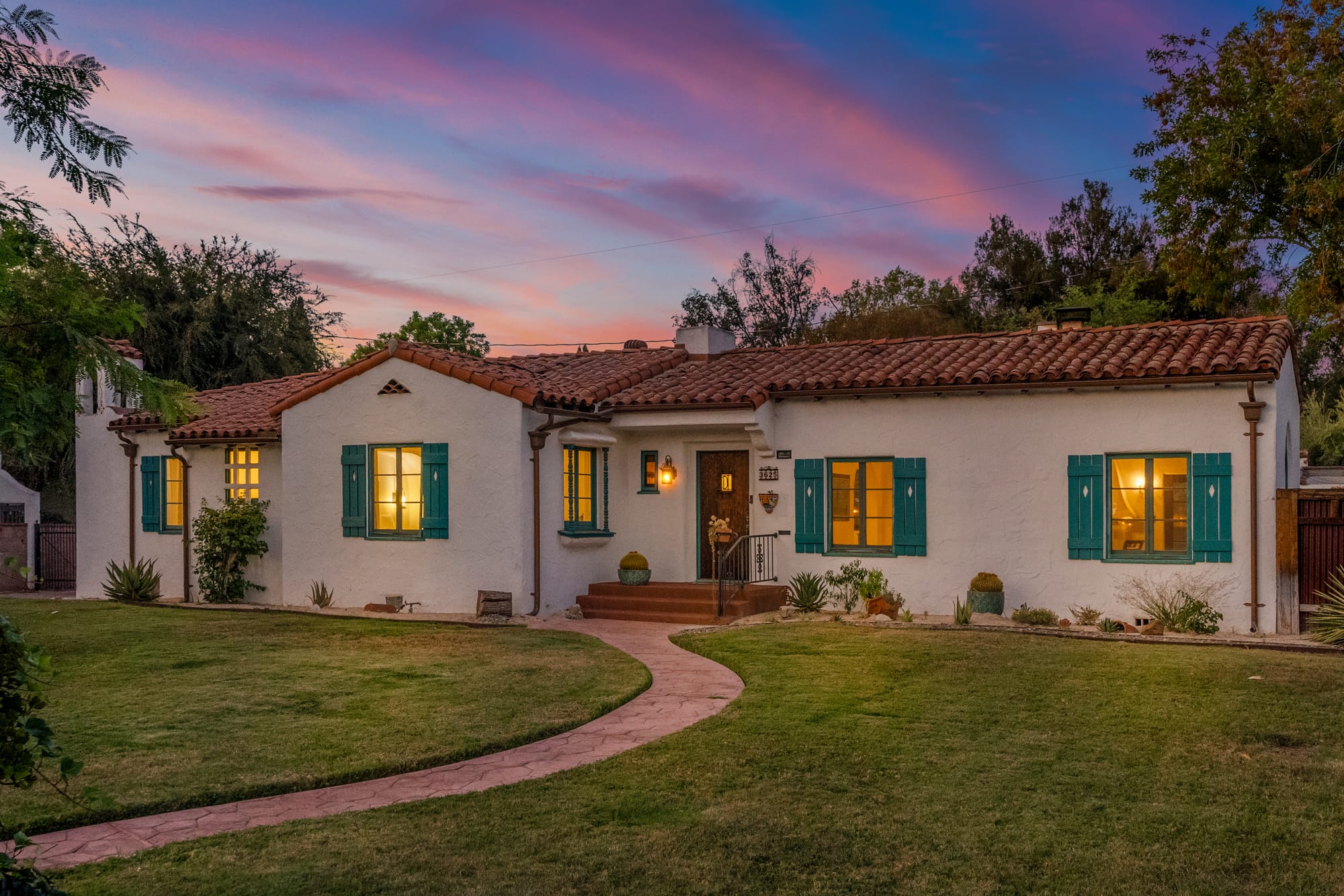
"My wife's favorite style has always been Spanish Andalusian. I had always wanted to live in a California Craftsman," he said. "But this home is a joy to live in, and we're both super grateful to be here."
The couple were drawn by size — they were coming out of a 900-square-foot two-bedroom nearby — and proximity to friends. They've been chipping away at the restoration ever since.
"It's been a huge learning curve and investment to get to know the house, to restore it, and pay close attention to what it needs," Villalobos said. He pointed to the arches, decorative wood beams, hardwood floors, 1930s Calco Tile and the large windows the family opens to let breeze through. "It's a solid, sturdy house, but at the same time it requires a delicate touch."
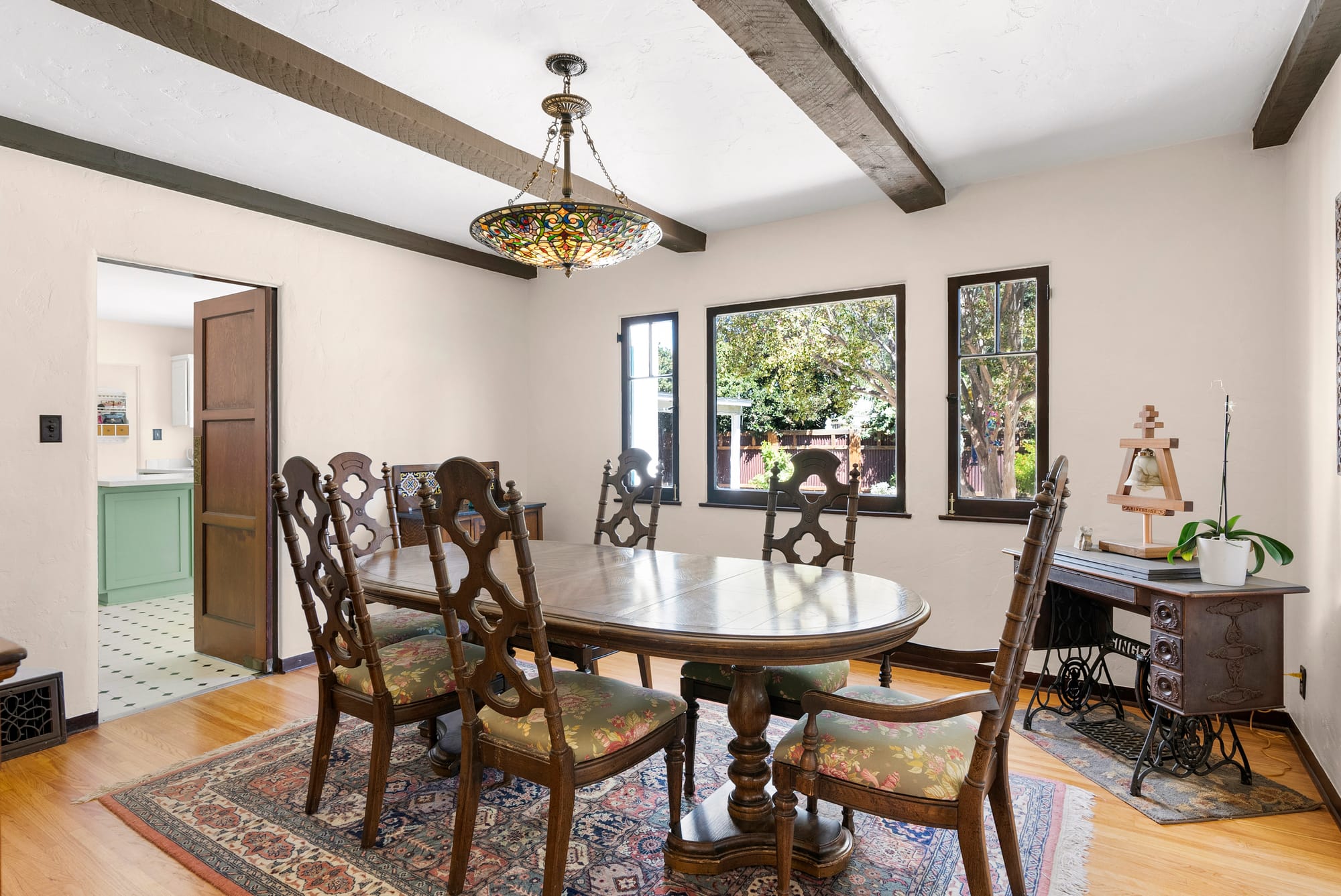
Villalobos has traveled extensively — including a three-week architectural tour through Andalusia in southern Spain to see the origins of his own home's style — and has come back convinced that Riverside's vintage stock is internationally distinct.
"There is nowhere else in the world with the types of historic properties that we have," he said.
He has a theory about why so much of that stock has survived intact: economic dormancy. Riverside had significant wealth when these homes were built, he said, but between roughly 1950 and 1990, capital here lagged coastal Los Angeles, Orange County and San Diego.
"People didn't have the financial ability to make massive alterations to their homes," Villalobos said. "As a result, it seems to me that Riverside in particular has some of the most well-preserved originality of any city in Southern California."
What he hopes tour visitors notice is the craft.
"As we moved away from custom construction and into the tract neighborhoods of the post-war years, the main thing that started disappearing was decoration. Beauty for beauty's sake," he said. "It's usually the tile work on fireplaces and in bathrooms, carved beams, arched niches, railings, and carved wood balconies that get people excited."
The Old Riverside Foundation was founded in 1979, a few years after the city demolished broad sections of downtown to make way for a new City Hall and other civic buildings — themselves now historic landmarks in their own right. It was the era when there was talk of razing the Mission Inn for a sports stadium.
"I am thankful for the Riverside citizens — mostly women, I may add — that started the conversation about preventing the mass destruction of swaths of Riverside in the name of 'progress' in the early '70s," Parrish said.
ORF's earliest landmark advocacy was for the Peter J. Weber House, which received city landmark status in 1981 after Days Inn — the property's then-owner — pushed for demolition or relocation to clear room for a hotel parking lot. The Cultural Heritage Board ruled the house had to stay where it was; the hotel built around it. ORF has been the Weber House's tenant and caretaker since 1990, and the building serves as basecamp for the tour each year. A new biography of Weber, written by ORF President Dave Stolte and researcher Ruth West, will be on sale at the Faire.
"Just think of what would have happened if the Days Inn had been able to raze it," Parrish said.
Ticketholders receive the full list of six addresses — five private homes plus the Weber House — by email the week of the event. The tour is self-guided and starts at 10 a.m. Visitors can take the homes in any order they choose. Docent volunteers walk guests through each home's architectural and decorative details. Each visiting group receives a printed tour book explaining each house's history.
This year's docents are drawn from across Riverside's preservation community: the Riverside Historical Society, the Woman's Club, Evergreen Memorial Cemetery, the Mission Inn Foundation, the Riverside Renovators and what Parrish calls "lovers of old houses." Many have been involved with the tour for more than 20 years.
Basecamp at the Weber House hosts the free Restoration Faire & Vintage Mercantile, open to the public with no ticket required. Antique dealers, vintage-home contractors specializing in things like ironwork and roofing, and ORF's salvage operation will all be on hand. The Weber House itself will offer free tours throughout the day, and every ticketholder is automatically entered in a raffle.
A $30 ticket is also a small preservation grant.
About $15,000 of annual tour revenue feeds ORF's Restoration Grant fund, which awards up to $2,500 at a time to ORF members for restoration work on their historic homes — typically focused on areas visible from the street. The architectural salvage program supports the foundation's operating expenses, including ongoing maintenance and restoration of the Weber House itself.
On May 16, five Riverside front doors open. The American story will be told from the inside.
More information: The 33rd annual Vintage Home Tour will be held from 10 a.m. to 4 p.m. on Saturday, May 16, with basecamp at the Peter J. Weber House, 1510 University Ave. Tickets are $30 in advance through vintagehometour.com and $35 day-of at the Weber House. The Restoration Faire & Vintage Mercantile is free and open to the public.


