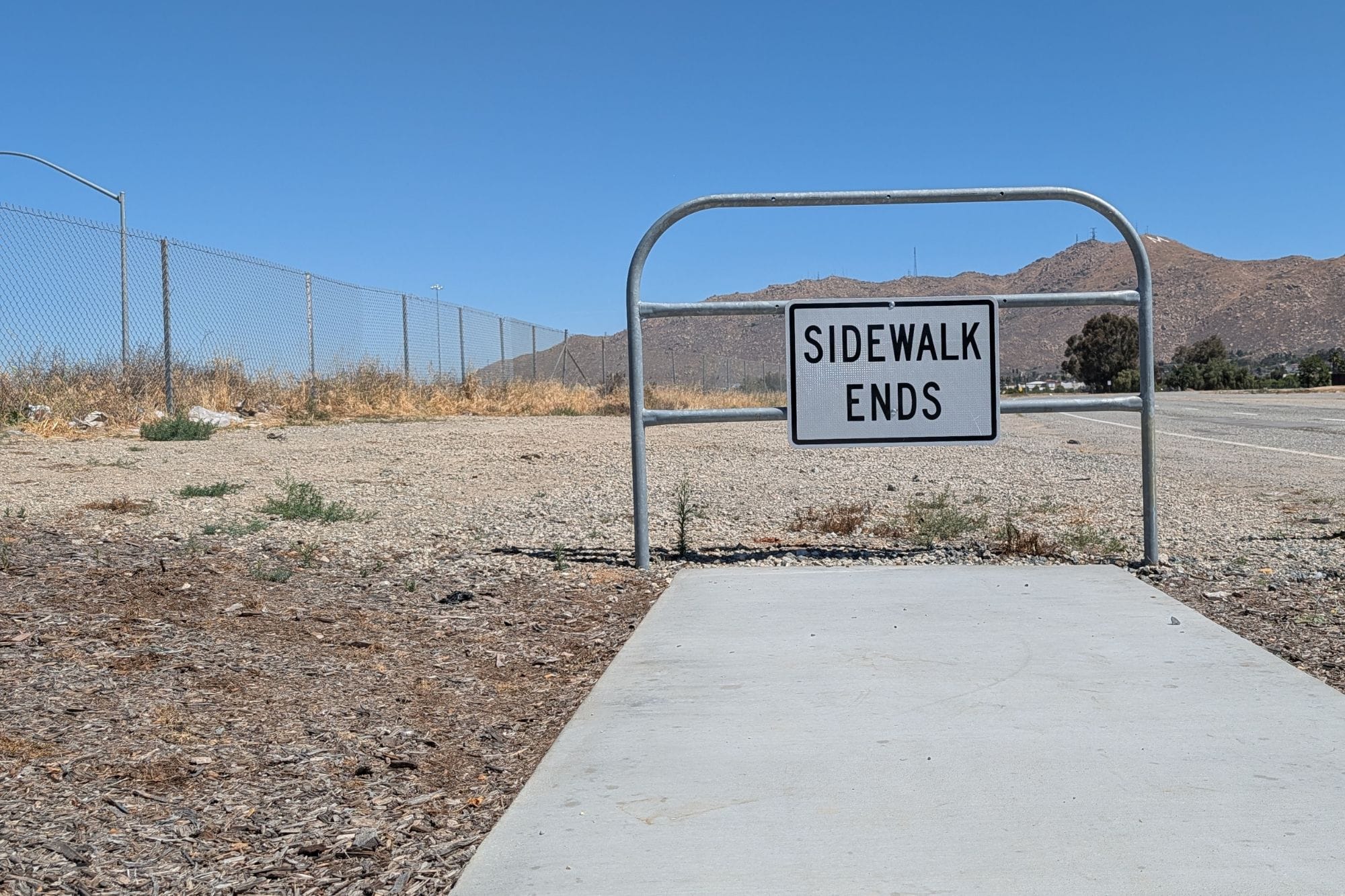
Old 215 Frontage Road is not trying to charm anybody. It has no trailhead sign, no interpretive panel, no invitation to explore. I am walking the old frontage road between Eucalyptus and Alessandro, out on the east side and back on the west; about a mile each way.
It's midmorning and already close to 80 degrees. I should have brought two iced coffees. At least I remembered the hat and sunscreen.
This road runs along the border of Riverside and Moreno Valley. Or near it. Or through it, depending on which parcel you stand on. The division between cities is not as clean here as people prefer borders to behave. It hops around.
That uncertainty is part of the walk.
At Eucalyptus, the Moreno Valley side, I begin on dirt and gravel. The shoulder is wide enough to keep me several yards from the cars and trucks. I walk facing traffic because this is what you do where there is no sidewalk and the speed limit is 50. Cars come around the curves quickly. A sheriff's patrol is out watching for speeders, and I feel grateful the motorists are nudged towards safer driving habits when I'm walking steps away without a helmet.
The modern I-215 runs parallel, trying to carry all the people and things of the Inland Empire to their desired destination as quickly as possible. Drivers who know the area use Old 215 Frontage Road to avoid the commonplace gridlock of the 215/60 interchange. It's not really much faster, but at least you keep moving.
I drove this road regularly when I lived in Orangecrest in the 90's and Moreno Valley was more convenient for shopping and entertainment. Walking it, I see how much I missed through the windshield.
Empty lots have been recently disced for fire mitigation. The soil lies in broken rows, not planted, infused with weeds, plastic packaging, drink cups, chip bags, old tires, and hubcaps. It has the look of a field after a harvest, except what keeps returning is not wheat or citrus or alfalfa. It is what gets tossed from cars on their way to somewhere else. The objects have been folded into the dirt, as if the field has been asked to compost what cannot break down.
Moreno Valley contains older single-family homes, small repair and retail shops, and a new three-story apartment complex. There is a conflict between what each city sees as the challenges and opportunities available here. Across the street, the Riverside side, warehouses and light industrial buildings sit behind fencing, sidewalks, and landscape strips; most of it built in the last decade.
Crossing Bay Avenue, the old road reveals signs of its earlier life. The New Star Motel, established in 1953, has a midcentury confidence softened by age. It belongs to the era when travelers needed rooms close to the main road. The Inland Empire has many such buildings, built for one kind of dream and adapted to another when transportation routes change. The nearby adult bookstore's parking lot is full.
A little past the American Legion Hall I jaywalk quickly to the west side of the street to head back to my car. Walking is easier on the Riverside side thanks to the wide level sidewalk. The manicured easement makes the road much less of a safety concern. There is landscaping. There are young trees offering intermittent shade. The sun is at my back.
I like nature in the city, the birds on utility wires, the weeds pressing through fence lines, the sudden bougainvillea, the cactus that needs nobody. In a landscaped strip, half-settled into the wood chips, I find a single Bluetooth earbud. I pick it up because I have a use for things like this.
At home, I'm making a sculpture using small, discarded technologies: earbuds, chargers, phones, remotes. Things that make life easier until it's time to dispose of them. I like them as material because they are intimate trash. They touched and connected people, then were discarded.
Most of the people I see are employees: Landscapers, mechanics, a warehouse worker on break. At the creek crossing, where chain link fencing obscures a small drainage thick with trees and brush, I see evidence that people have been staying there. Blankets. Food containers. A man comes up from the creek while I pass. We do not speak.
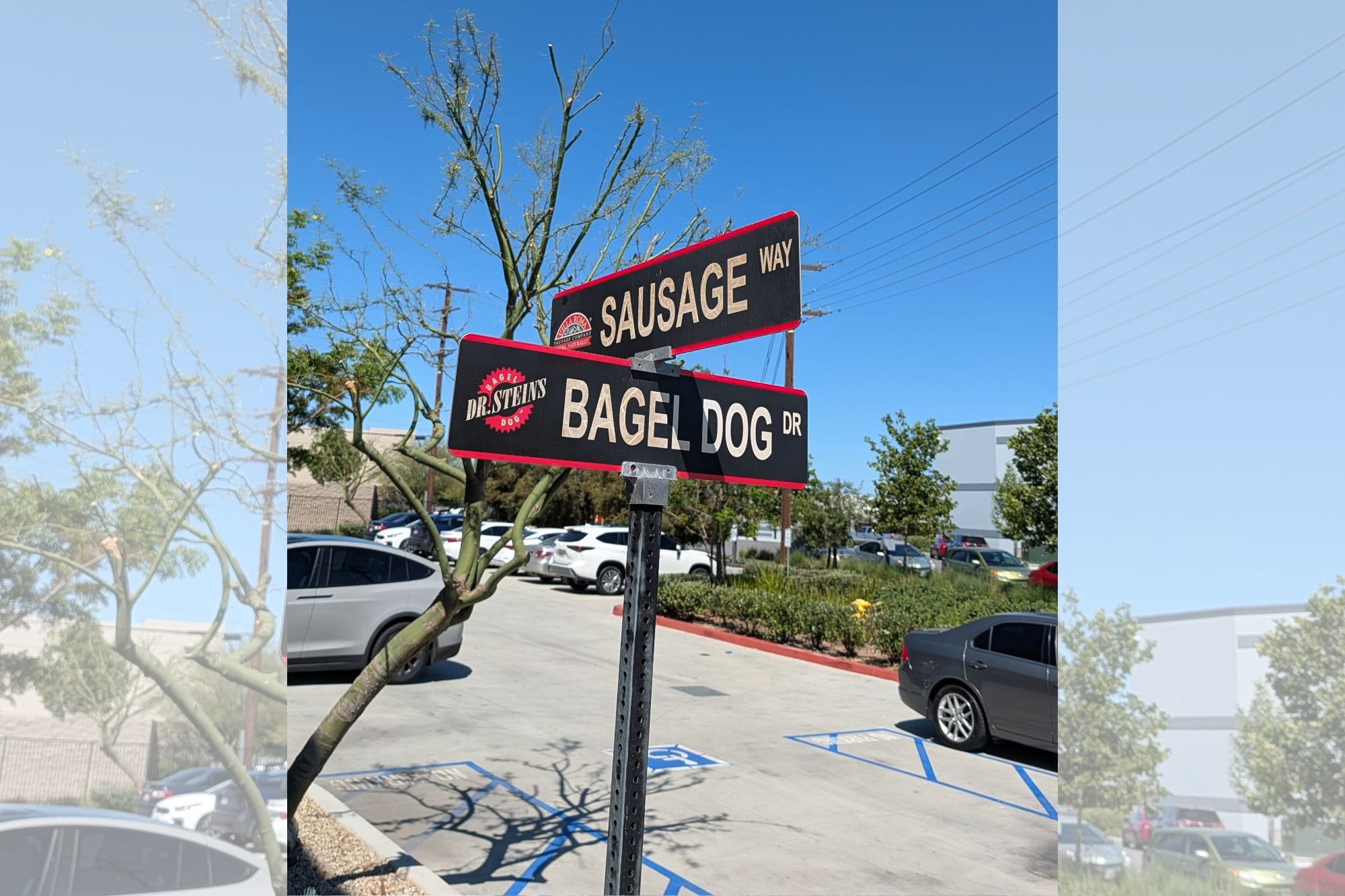
Approaching Cottonwood Avenue, outside Via Roma Sausage Company, I find a cute sign for Sausage Way and Bagel Drive; worth a quick parking lot selfie. This is the kind of discovery a walk allows. Riverside has many roadside attractions; some are visible only at three miles per hour.
The old highway and the newer interstate sit beside each other like two answers to the same questions. How do people move through this place? What should they do while they are here? What is possible here that is not possible somewhere else?
I do not want to romanticize Old 215. It is not a hidden gem. It is not a pleasant stroll in the conventional sense. I would not tell anyone to walk it casually without paying attention. But I would say it is worth seeing, because it shows something true about Riverside and the cities around it.
It shows how land adapts without fully erasing what came before. It shows how city borders matter and fail to matter. It also shows how life and meaning persist in the face of change. Streets like this exemplify Riverside's story as clearly as any landmark.
Riverside's character is not only in its preserved buildings, mountain views, or citrus history. It is also along old roads where development arrives unevenly, where people improvise, where a sidewalk may end before the journey does.