

Philip Falcone is a Riverside City Councilmember, and in love with the history of the city. This spring he is working as a first-time curator, joining Daniela Guzman and Arman Agahi to assemble "Riverside: An All-American City," a celebratory gallery exhibition at the Mission Inn Museum marking the country's 250th anniversary.
The title is not arbitrary. Riverside won the All-America City designation in 1955 and again in 1998, awarded to cities that demonstrate civic engagement and innovation. The show draws from the Mission Inn Foundation's archive built by Frank Miller, pieces from local collectors, and a portion of Falcone's own personal collection.
Councilmember Philip Falcone knows his stuff.
Standing inside the gallery at the Mission Inn Museum, he can tell you which items belonged to Frank Miller, which ones came from local collectors, and which ones are his. The gallery is small and bursting with red, white and blue.
"This side of the room is Frank Miller's," he says, gesturing to one side, "and then everything on this side of the room is mine."
The exhibit is, in some ways, a scaled-back version of a grander vision, though it is well worth the visit. The 250th might have been better served at the still-under-construction Museum of Riverside. Falcone reached out to the much smaller but more available Mission Inn Museum. Staff there pulled everything American-related from the collection, and the three curators started building from there.
What emerged breaks into three sections: artifacts from Miller's era, including pieces tied to his lifelong advocacy for international peace; items connected to presidential visits, from Mission Inn overnight stays to LBJ's 50,000-person rally at the historic courthouse; and objects from the 1976 bicentennial. The presidential section alone carries enough history to fill its own room. Nixon and Pat were married in the Mission Inn's Presidential Suite in 1940. The Reagans honeymooned there in 1952. And in 1960, Kennedy's campaign set up its Riverside County headquarters in the Inn's International Rotunda, while running against Nixon, who had his own deep ties to the same hotel.
The exhibition logo came from that same archive. Falcone and the team adapted a George Washington graphic design originally created for a Mission Inn menu, removing the hotel's text and inserting the exhibition title. The 1914 July 4th midday meal menu that inspired it is on display in the gallery.
Falcone is drawn to the aesthetics of centennial celebration, the Stars and Stripes motifs, the heavy nostalgia. What he loves about the bicentennial material specifically is how it absorbed the visual vernacular of its own era, the '70s funkiness pressed up against 1776 iconography. "We're not doing Independence Hall, Philadelphia, classical Americana," he says. "It's a little more funky than that."
The deeper interest for him is what the bicentennial meant in context. 1976 was not a good year. Watergate had forced a presidential resignation. Inflation was grinding. Vietnam was a fresh wound. And yet the bicentennial worked as a reset, a moment when shared heritage didn't require agreement on current events. Falcone thinks about that a lot right now. "I think we've allowed this general idea of patriotism to be co-opted," he says. He is not interested in patriotism as a political signal. He is interested in it as a baseline, something the exhibition itself states plainly: all are welcome, from varying political views and cultural backgrounds. The artifacts here are small pieces of a 250-year story that is still being written.
That thread runs through Frank Miller's collection too. The "Peace Among All Nations" flag, dated to around 1926, anchors the older section of the show, a reminder that Miller spent his life advocating for international friendship and a world free of war from the Mission Inn, only feet from the museum. It hangs in the same room as a Kennedy inauguration pennant, wartime ration books from Magnolia Avenue grocers, and Press front pages from the day Kennedy was killed. Objects from very different moments, in the same room. Falcone filled this little space with intention.
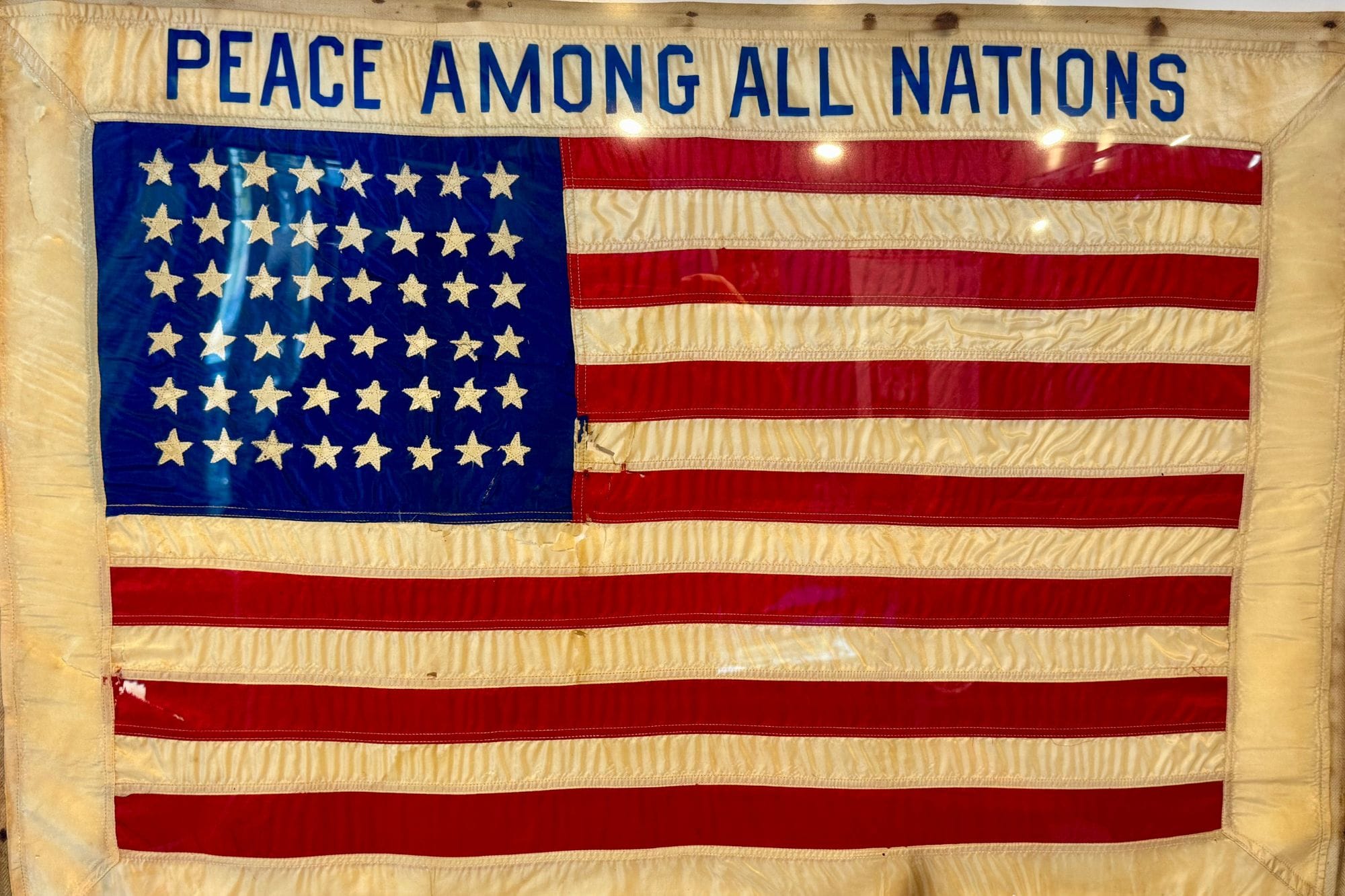
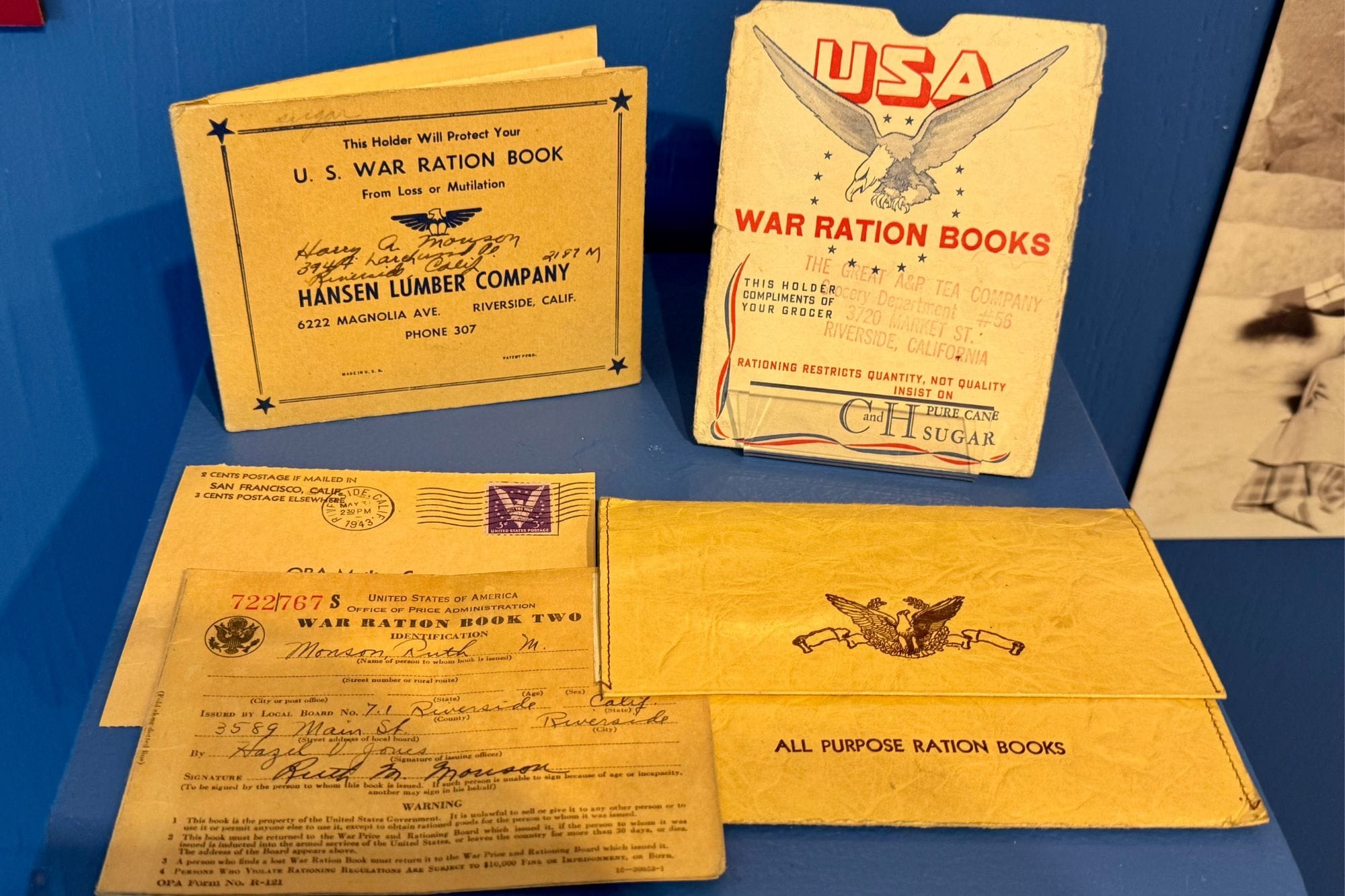
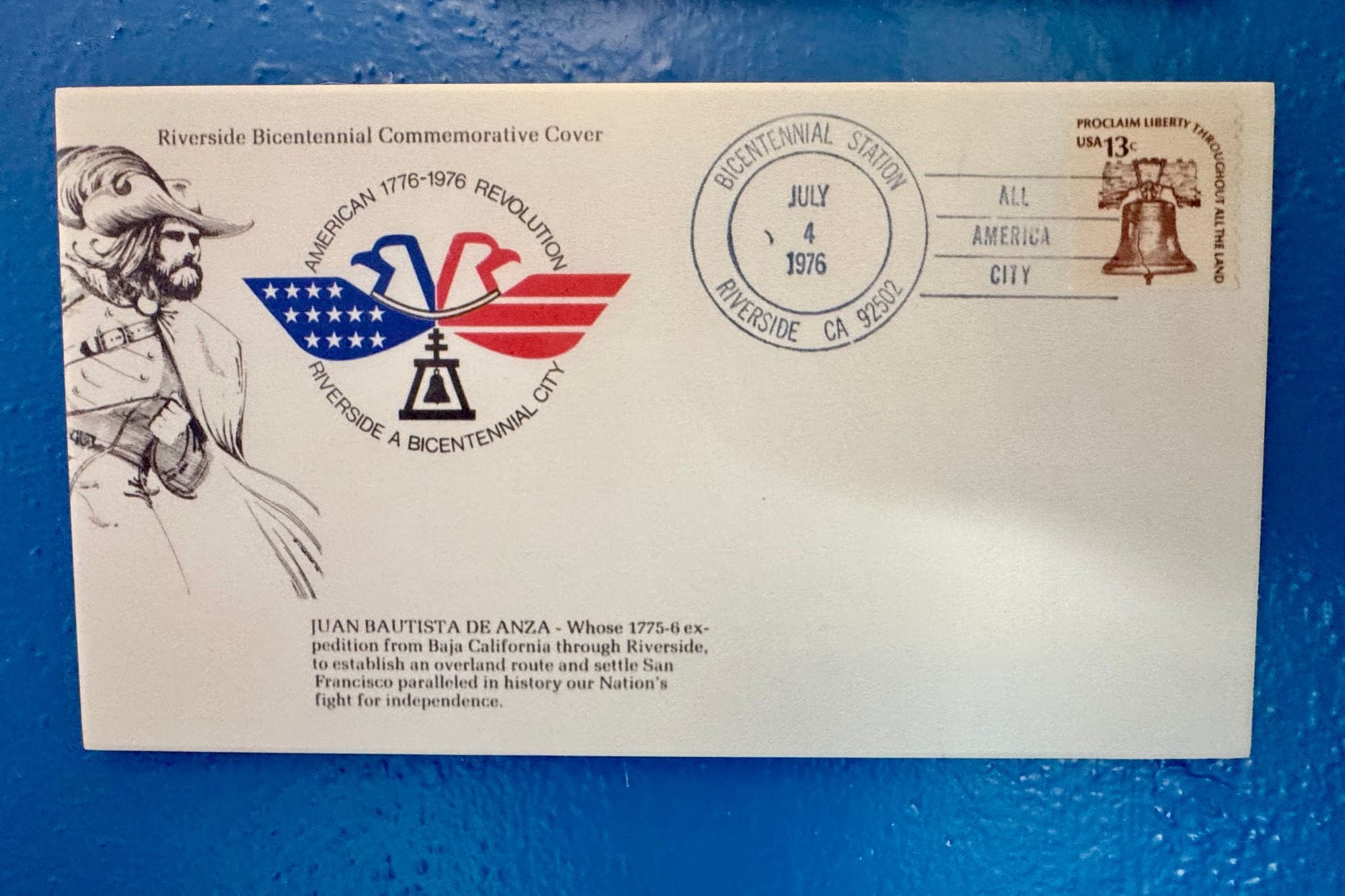
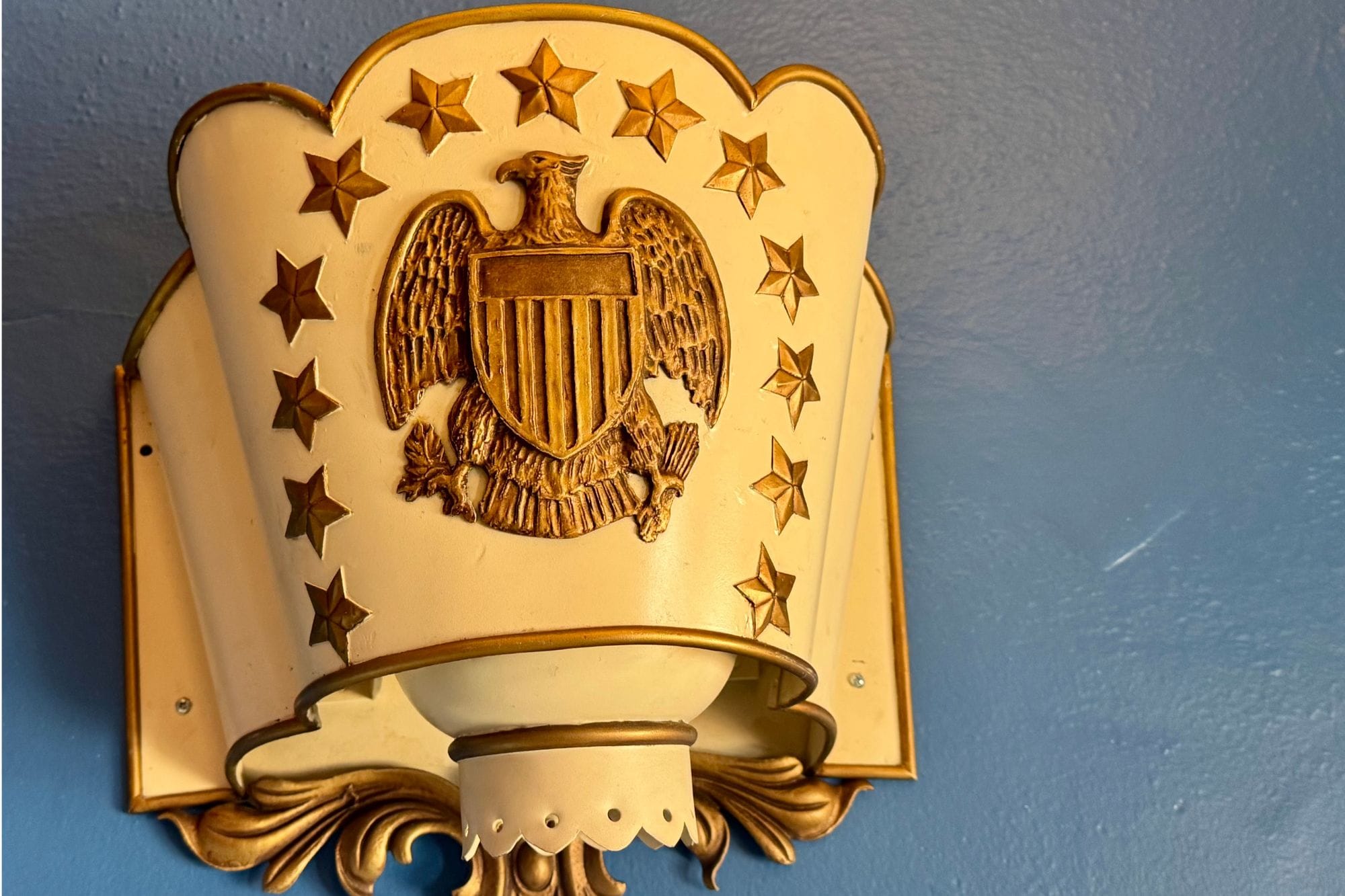
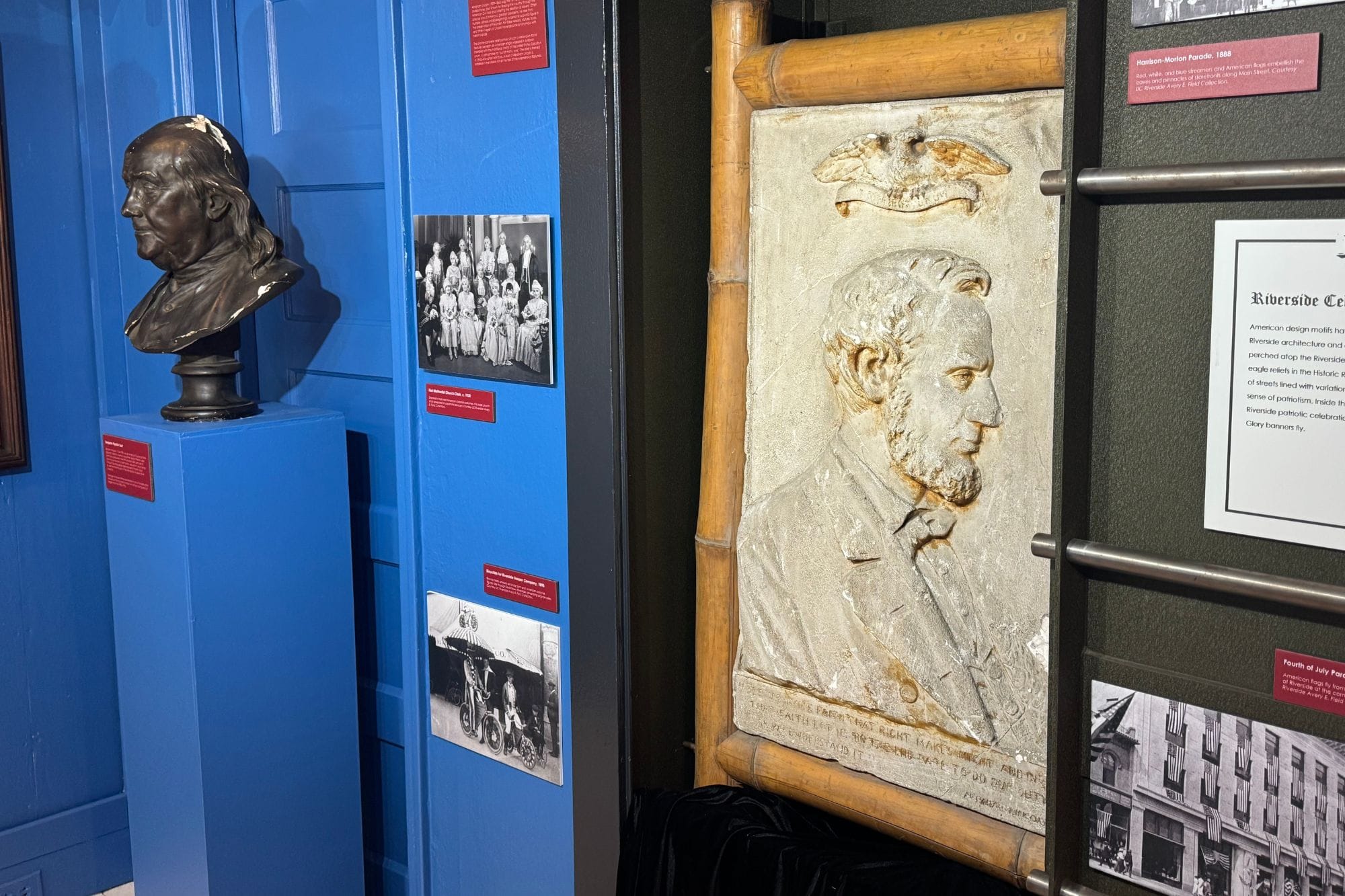
A selection of artifacts from "Riverside: An All-American City," on view at the Mission Inn Museum through August 3, 2026, including Frank Miller's "Peace Among All Nations" flag, Riverside's official 1976 bicentennial commemorative cover, wartime ration books issued to Magnolia Avenue grocers, and a patriotic wall sconce bearing 13 stars — one for each of the original colonies. (Ken Crawford)
More information: "Riverside: An All-American City" is on view at the Mission Inn Museum, located at 3598 Main St. in Downtown, through August 3, 2026. Museum hours and admission information are available at missioninnmuseum.org.


