

Late morning is a good time for Placentia Avenue. Between eight and eleven, before the sun turns insistent, the air is still cool enough that a jacket feels optional and a hat feels wise. The sky is clear except for a few high clouds. One block over on Center Avenue, trucks pass now and then, and somewhere in the distance a piece of equipment keeps working. But on Placentia itself the main impression is quiet.
I start at the corner of Orange Street and Placentia Avenue; my plan is to walk to where the road dead ends at Center Avenue and turn around and walk back same way, a little under two miles in all. It is not a dramatic walk, and it is pretty flat. That is part of why I like it.
Center Avenue is a corridor. It carries traffic, deliveries, errands, and the daily rush between the 215 and downtown. Placentia is where the pace slows. It is where people who live nearby walk, where cyclists come through to get a few miles in before the day warms up, where small birds work the edges of the fields without too much interruption by commerce.
I first got to know this street in early 2024, when I spent five months working nearby at Trujillo Adobe. I was there as part of a California Arts Council-funded project, making assemblage art from found materials. The keepers of the Trujillo Adobe were kind enough to let me convert the front of their lot into an interactive roadside exhibition. The idea behind my project was simple: our civic, natural, and social environments are full of objects people have discarded, and those objects still say something about who we are. Sometimes they still have use. Sometimes they still have beauty. Sometimes they just need someone to look at them long enough to see past the fact that they were thrown away.
That daily engagement with a place for a season changed how I saw Placentia Ave. At the time, the road was a place where illegal dumping happened. New piles of debris appeared regularly: office furniture, broken wood, plastic, tires, construction leftovers, things somebody no longer wanted and did not bother to dispose of properly.
But the street was never just an unregulated dump site. Even then, it had a pair of older homes, a handful of businesses, open lots, and the beginning stages of another warehouse going up. It was already a mixed place, part neglect and part persistence, part working landscape and part leftover puzzle piece.
Coming back two years later, what strikes me is how much has changed in a short time, and how much still has not. The warehouse is finished. Its landscaping is in, the sidewalk and curb and gutter are complete, and the back side of the property now looks planned five years into the future. The young uniform trees are staked. The shrubs sit in ordered lines. The building is all sharp edges, clean walls, and deliberate geometry.
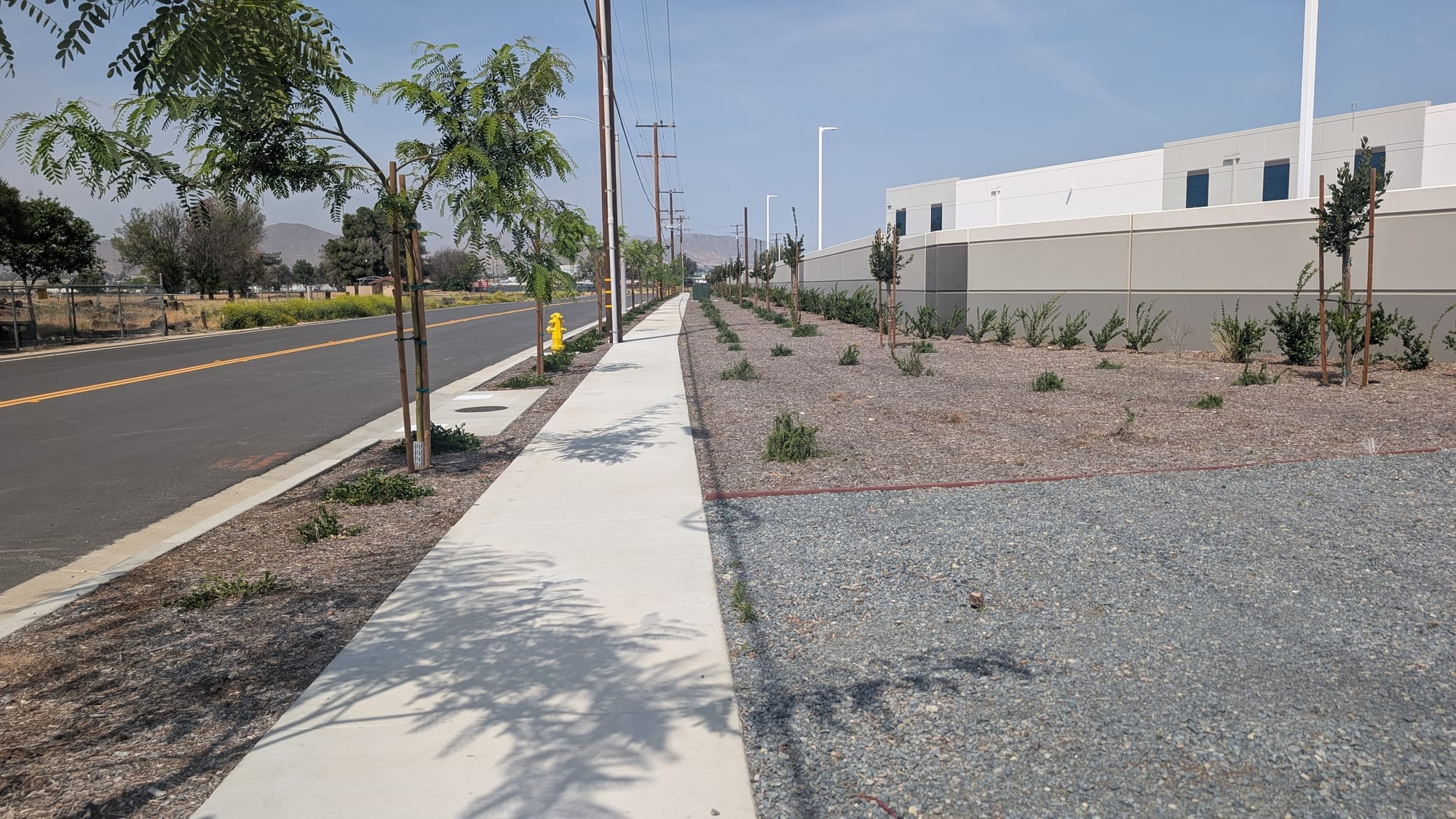
Across the street, the older Placentia is still visible. There are open fields, gravel lots, a city well, weathered fencing, old wooden telephone poles stacked in slowly decaying piles, and dry grass gone gold. There is still some trash here and there, though not nearly as much as I remember from 2024. These objects look to me like leftovers from an earlier version of the street, pieces that have not yet been hauled away or folded into the next strategic plan.
What I like most about this stretch is that both sides of the road tell the truth. The landscaped side says Riverside is still growing, still building, still trying to look prepared for what comes next. The field side says growth rarely arrives all at once. Places stay uneven for a long time. They hold onto older shapes and older rhythms while the future is being surveyed around them.
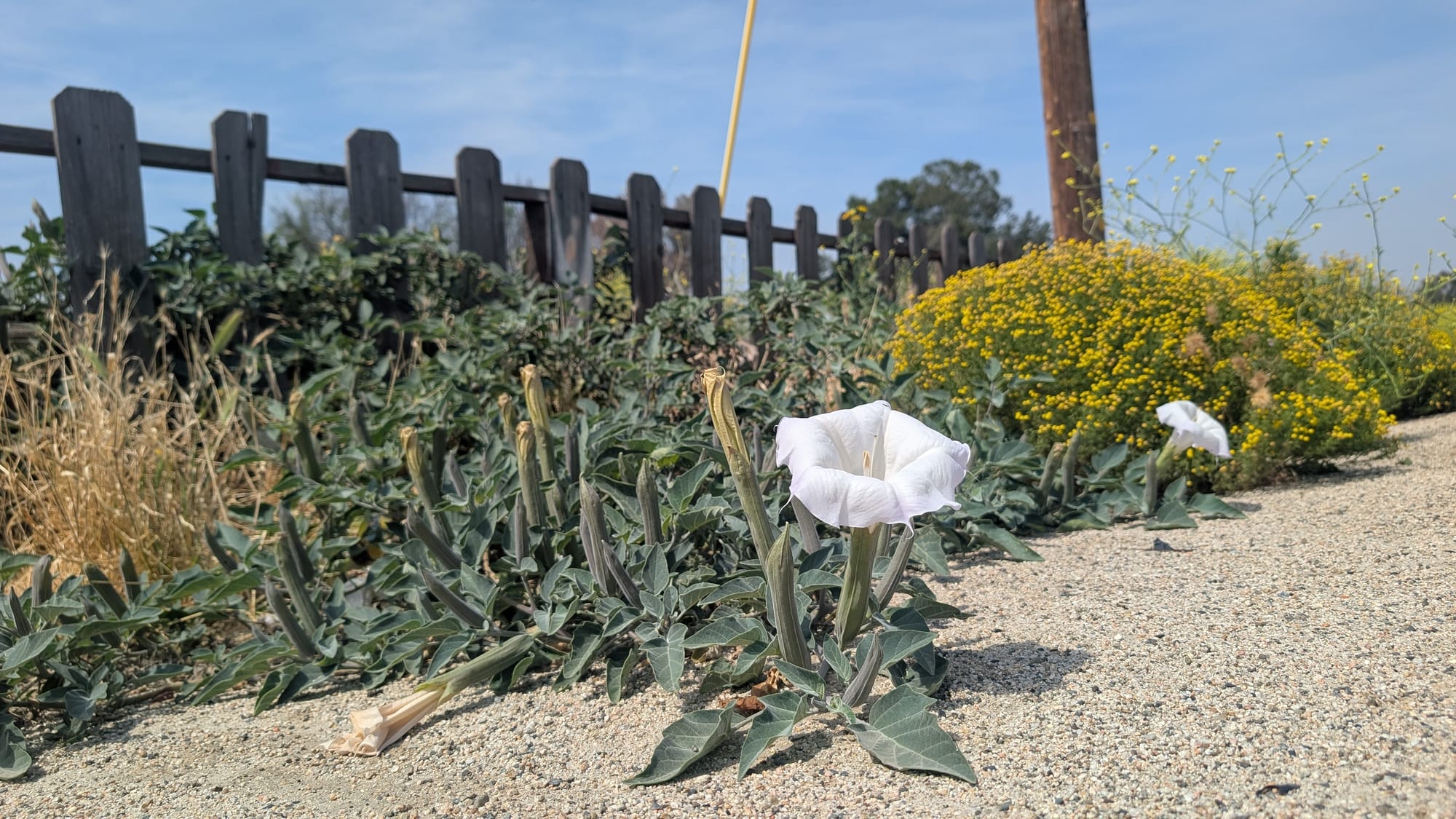
The plant life reflects this as well. On the warehouse side, everything is selected, spaced, and maintained. On the field side, beauty shows up more casually. Yellow wildflowers crowd the roadside. A white trumpet bloom opens out of pale gravel. Weeds push through dry soil and old fence lines. None of it is ornamental in the usual sense, but it is not hard to admire. It is the beauty of things that can survive where they are not especially invited.
That may be why this street stays with me. My art practice has always pushed me to look at what gets overlooked. Not to romanticize neglect, but to notice that disuse is not the same thing as worthlessness. A road can be quiet without being empty. A lot can be untended without being lifeless.
A discarded thing can still be worth looking at with attention and curiosity. I've found many strange and interesting objects to incorporate into my art over the years. By far, my favorite find was the day I discovered a working upright piano on Placentia Avenue.
During those months making art outside in the shadow of the Trujillo Adobe, I came across it there along the road, as if someone had set it down between one life and the next. I sat down and played it, not especially well, but loudly. Two neighbors walking by stopped and joined me for a bit. We talked. We listened. For half an hour, the street offered something more than scenery. It offered company.
The next day I came back thinking I might drag the piano over to the Adobe and make it part of the exhibition. It was gone. I am glad now that I never got the chance; a working piano belonged in a home more than it belonged in my silly exhibit. I like to imagine a family somewhere in Riverside with children learning scales on an instrument they could not otherwise have afforded. That seems like the right ending for an object that had been abandoned.
Placentia Avenue is not going to stay like this. The proposed sports complex and entertainment district nearby will change the area again, just as the new warehouse already has. In a few years this road will be busier, tidier, and harder to recognize. That is the nature of a growing city. It is also reflective of the question facing Trujillo Adobe as restoration and preservation move forward: how does a place hold onto its history while the world around it modernizes? How much can change before a place becomes something else entirely?
Walking Placentia now, I do not feel nostalgic for a perfect past. That is not its value. Its value is that it lets you see Riverside in one of its in-between forms: part field, part warehouse, part neighborhood, part work zone, still quiet enough for birds, cyclists, walkers, and a person with an artist's eye to notice what remains. Long before the latest plans, this was already a route through open ground. It still is. For now, at least, that is enough.


