
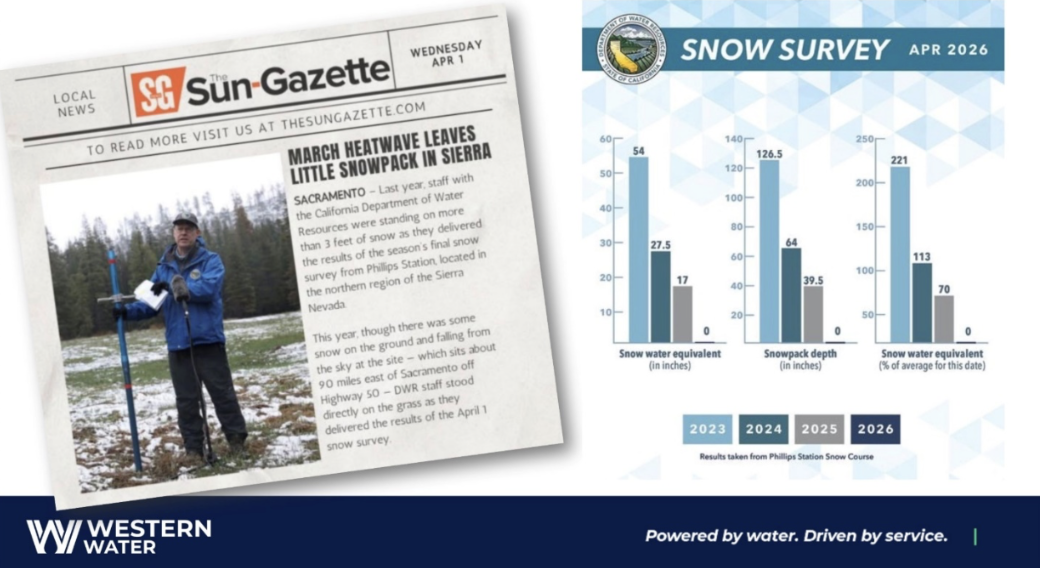
As our climate continues to warm and shifts to longer dry periods and shorter, more intense, wet periods with more precipitation in the form of rain and less snow, water providers are concerned about longer term supply if 2026 turns out to be a dry year. On the plus side, California and the Colorado River Basin both had a pretty good year in terms of overall precipitation, but warmer storms with rain rather than snow and a historically warm March destroyed the snowpack that would normally provide capturable runoff throughout the spring. The graphic below shows April snowpack for the last four years. As you can see, we didn't have any this year.
The rapidly melting snowpack and rain runoff did a great job of filling California's reservoirs, but there was far more runoff than there was room to store it and a great deal simply flowed out the Golden Gate into the Pacific Ocean. On the Colorado River, little water was lost and storage in Lake Mead significantly increased although both Lake Mead and Lake Powell remain far below full capacity.
Notably, 2026 is the first year in a quarter century that none of California was considered to be in some stage of drought. This, coupled with full reservoirs will get us through 2026 with no issues, but the reservoirs will draw down rapidly if we have a dry summer and fall.
Weather forecasts are varied, but there is a strong indication an El Niño is forming, and precipitation in El Niño years varies from very little to a great deal. We will have to see what the summer and fall bring. If it is a dry year we may face reduced allocations of State Water Project water next year.
Overall, California can handle a three year drought with some inconvenience and additional conservation, but anything longer is likely to result in draconian cuts in water supply. The passage of Senate Bill 72, which requires the state to identify an additional 9 million acre feet of water supply by 2040, and Governor Newsom incorporating this into his water plan bodes well for the future. Although the planning effort is just getting underway it seems likely it will include the Sites Reservoir project which will store 1.5 million acre feet of water collected in times of high runoff for use in times of shortage. This project has been in planning for decades and is finally getting to its final permitting stages. Preliminary construction could begin as early as late this year or early 2027 if there are no further delays.
Interagency cooperative agreements like the one recently executed by Western Water and the San Diego County Water Authority put our region in a good position to share water resources across jurisdictional boundaries (see last month's Gardner Gauge for details on this historic agreement). Western's sister agency, Eastern Municipal Water District, signed a similar agreement with San Diego earlier this month. These agreements also provide a degree of protection for Western and Eastern in the event of a reduction of deliveries through the State Water Project.
We must also anticipate a reduction in Colorado River water available to California. The seven states, 21 Tribal nations, and the country of Mexico, each of which have some level of rights to Colorado River Water, have still not reached agreement on how to share a reduced supply of Colorado River water. There was a Valentines Day deadline to reach agreement which passed with no action. If the parties cannot reach agreement, the US Bureau of Reclamation can mandate allocations. Regardless of how reallocation of rights is decided, California will certainly receive less Colorado River water than it does today despite the significant cutbacks we have already made.
All of this emphasizes the need for California to build new infrastructure to capture and store excess water when we have it for use during the inevitable dry periods.