
Legal Firms, Community Urge Council to Reconsider $20.1 Million Homekey Grant
Advocates warn Riverside's rejection of a grant to house 114 homeless residents may violate fair housing law — but the window to reconsider may have closed.
Advocates warn Riverside's rejection of a grant to house 114 homeless residents may violate fair housing law — but the window to reconsider may have closed.

Three nonprofit legal firms, along with advocates and residents, rallied in front of City Hall Tuesday at noon urging the city council to reconsider its January rejection of a grant that would have housed 114 homeless residents – warning the council that the rejection might violate fair housing laws.
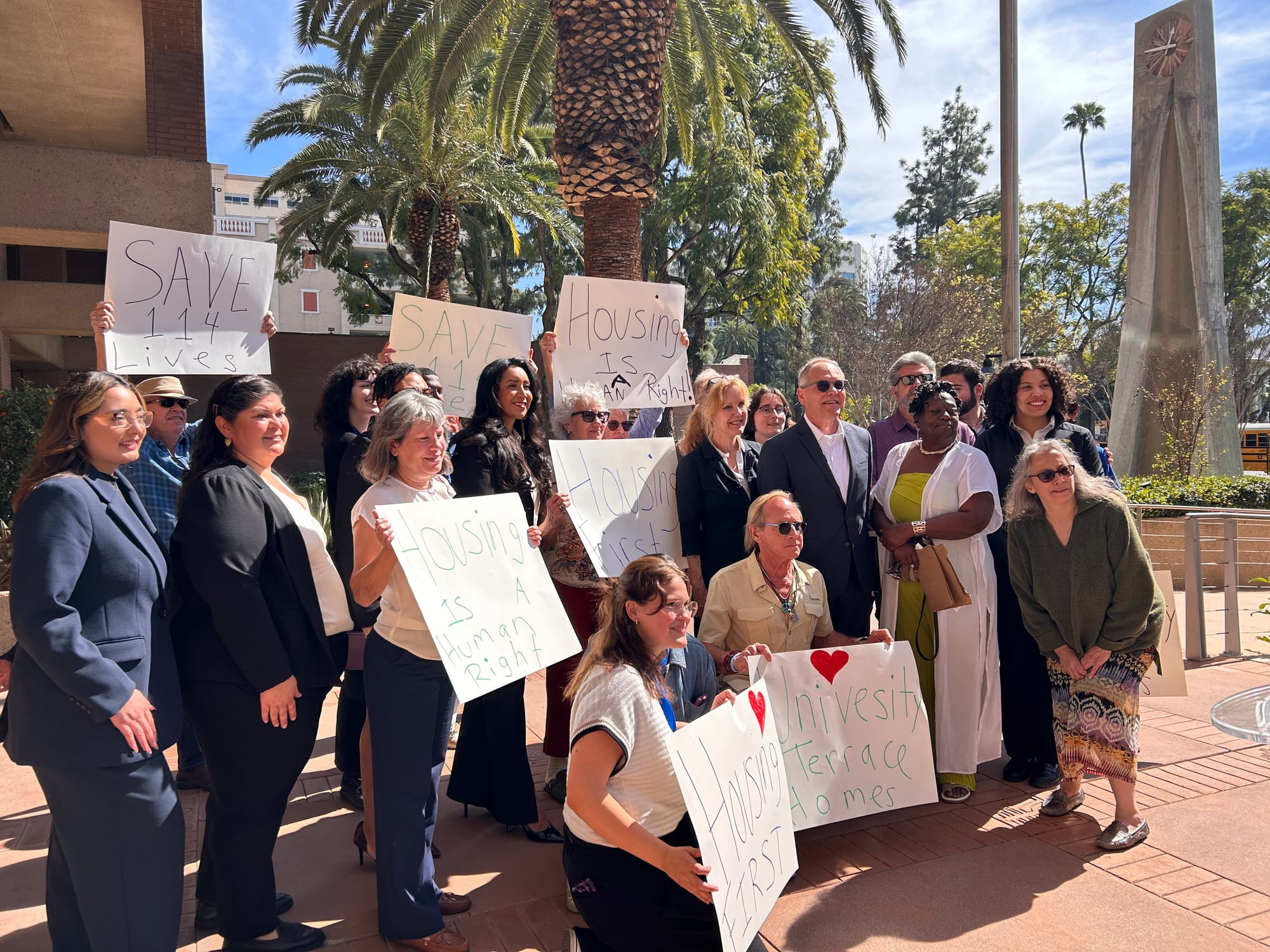
On January 13, the council voted 4-3 to reject a $20.1 million housing grant meant to turn the Quality Inn at 1590 University Avenue into 114 studio apartments for homeless and low-income residents. Since then, the council has faced several potential lawsuits and many disappointed residents asking the council to reconsider the grant.
The deadline for reconsideration of the vote – which would have had to happen within three successive meetings– has passed, according to a Feb. 27 statement by the city.
However, The ACLU of Southern California and the Inland Counties Legal Services sent letters warning the city that their rejection could violate the city's legally binding Housing Element Law and fair housing laws based on what the organization describes as stereotypes against unhoused residents.
The city confirmed on Feb. 27 that there is no current litigation related to the matter against the city.
The groups, along with the Public Interest Law Project, partnered on Tuesday to urge the council to reconsider, hoping that litigation and notice of possible noncompliance would legally allow the council to bring the project back to the dais despite the deadline's passing.
The groups said they are currently planning for "possible options" if the city does not bring the matter back for a vote – adding that they are in communication with the state's Housing and Community Development Department, as they have the power to more "effectively enforce" such matters.
Ward 2 Councilmember Clarissa Cervantes, who was the primary champion of the grant on the council, said the council will review the letter received from the Inland Counties Legal Services during a closed session next month.
"I respect the council's role in making difficult decisions. However, I believe turning away these resources represents a missed opportunity," she said at the press conference. "If we had moved forward with the project, there are over 300 individuals that are currently on a waitlist that are preapproved to immediately move in once this project were built, so we would be able to cut our waitlist by one-third."
Cervantes said that the council discussed potential litigation from the ACLU – as well as potential litigation from the property's seller – at the Feb. 11 meeting, but it has yet to discuss the Inland Counties Legal Services' letter because it was received too late for them to agendize it for closed session discussion during that council meeting.
Several residents also showed up to the rally in support of the reconsideration of the grant.
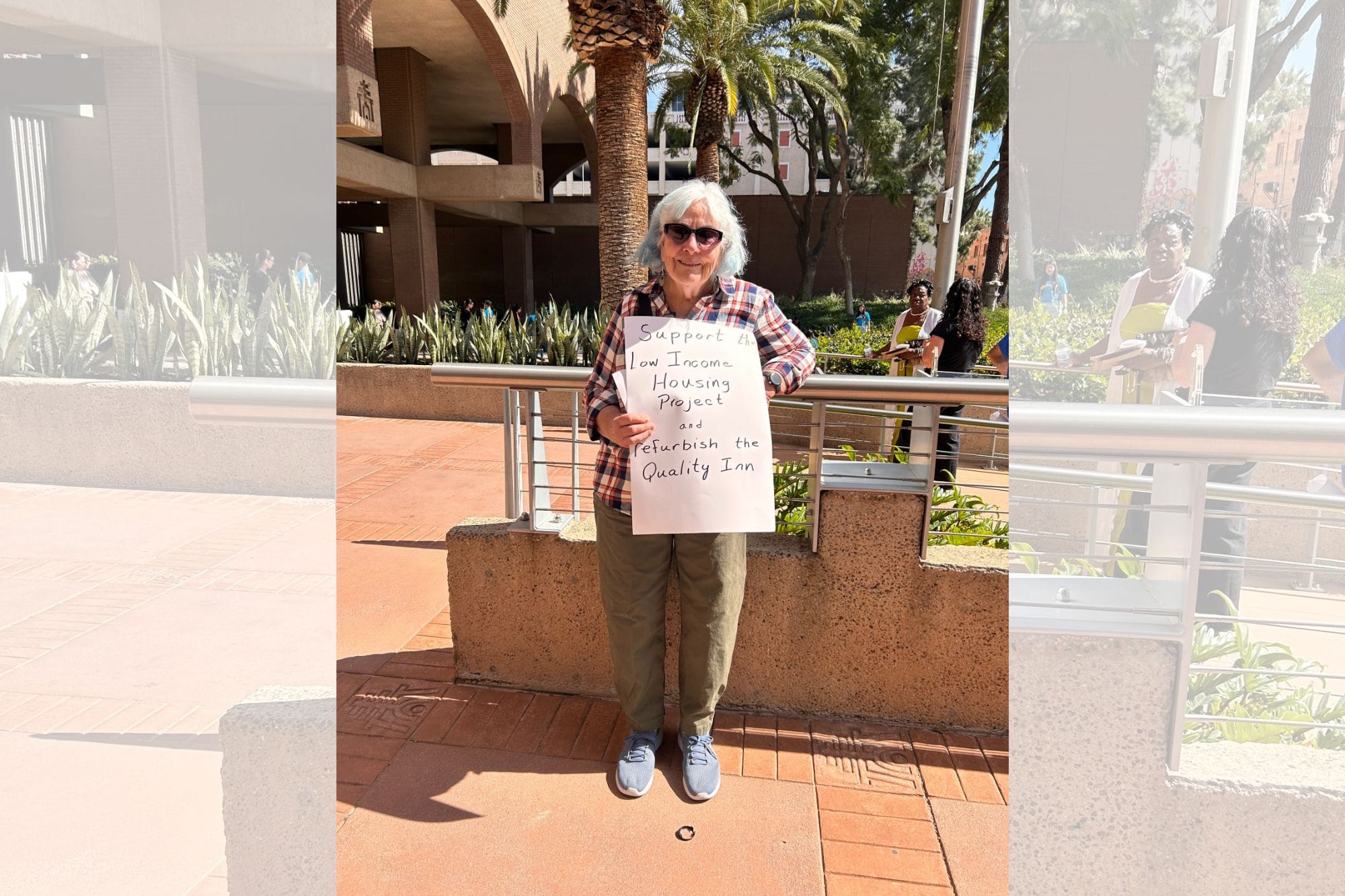
Resident Patricia Verweil, who lives near the Quality Inn, told the Gazette that the motel is currently a "magnet for police activity."
"This would refurbish it and give people a house. We've got so many homeless people wandering around the streets that it breaks your heart," Verweil said. "I'm out here because it's a good project. It's a well thought-out project, and it solves, in my opinion, two problems – the homeless situation is alleviated and the Quality Inn is cleaned up."
Resident Alan Vargas said he would like to see the councilmembers who rejected the grant offer more housing solutions.
"Council likes to say that they want to fight the homeless situation, but here we are rejecting money, a grant that would get our committee off the street," Vargas said. "So I think the council is rather blind or just morally ignorant about the importance of making sure our community gets off the street and actually offers solutions. Actually offers solutions, not just yelling at the dais, and hopefully that the solution just falls from the sky."
Resident Aram Ayra, who is also running for a council seat in Ward 2, added his thoughts.
"Frankly, certain councilmembers on this council have received funding from moneyed interests that are opposing this project publicly," Ayra said. "That is a concern when we're choosing to prioritize campaign donations over what's best for Ward 2 and what's best for the city and especially for our own unhoused population."
Other leaders also spoke at the press conference in support of the project's reconsideration.
A spokesperson for Senator Sabrina Cervantes, who represents Riverside in the state Senate, said at the press conference that "the council is jeopardizing the future of Riverside's access to vital resources."
"Their decisions to bow to special interests rather than champion the needs of our residents will make it much more difficult for me to advocate for our city in Sacramento," the spokesperson said. "Today, we stand united with community nonprofit leaders and housing partners to support the University Terrace project."
Councilmember Philip Falcone explained in a statement to the Gazette last month that part of his decision to vote "no" on the project was due to opposition from local businesses and residents in his ward.
"Businesses were not notified until the eleventh hour...most importantly, resident groups on the Eastside were lukewarm to it at best," Falcone said. "All of this could have been avoided if these partners were not blindsided."
Other councilmembers who voted against the project questioned whether the city's "Housing First" approach, which prioritizes placing people in housing without barriers to entry, would deliver sustainable outcomes.
In January, Councilmember Sean Mill, who voted against the project, argued that providing housing without addressing underlying mental health or substance abuse issues fails to help people.
"Housing First has failed," Mill said, calling the model "housing stabilization without human stabilization."
Councilmember Steve Robillard said in a March 3 op-ed in the Gazette that he disagreed with grant supporters' attempts to force the city to approve the project through litigation.
"The current discussion suggests that if the council will not approve this project through a vote, the courts should compel it. Because the procedural window for reconsideration has closed, litigation would now be the only mechanism to attempt to force the project forward," Robillard said.
"That approach should concern residents regardless of where they stand on the project itself," he said. "Public dollars should be allocated through open debate and transparent votes, not under the pressure of legal threats. When policy disagreements become lawsuits designed to produce specific fiscal outcomes, democratic decision-making is weakened."
Other opposition came from local business owners, who spoke against the project in January.
Beverly Bailey, whose family invested $15 million in the nearby Farmhouse Collective, questioned whether the development aligned with the city's vision.
"Our family invested millions of dollars into this part of Riverside...is this something that is just a bandaid or is this a vision for our city as a whole?" she said during a Jan. 13 meeting.
Since the deadline to reconsider the project has passed, the $20.1 million Homekey+ award is expected to return to the state, according to a Feb. 27 press release from the city.
By Micaela Ricaforte

With reconsideration deadline passed, councilmember argues litigation shouldn't override democratic vote on University Terrace.

City Council weighs revenue options for fire staffing, while boards take up speed limits and ethics rules.


A $1.54M federally funded contract will bring the improvements to the stretch beneath the landmark bridge at the Riverside-Jurupa Valley gateway.

From a missing watchdog to conflict-of-interest questions, residents raised pointed concerns — and on one item, got results.

Let us email you Riverside's news and events every morning. For free!